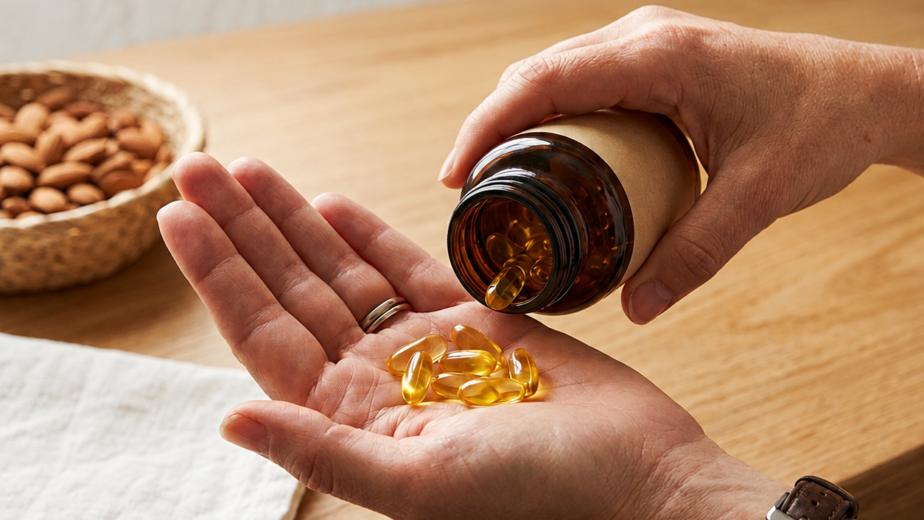
Check the label on almost any multivitamin and you’d find vitamin K2 there in the amount around 10, 20, maybe 45 micrograms, tucked into the fine print below the calcium and the B-vitamins. It’s enough to earn a line on the ingredient panel. According to the one trial designed specifically to test different K2 doses against each other, it may not be enough to change anything measurable in the body.
In 2012, researchers at Maastricht University ran the study where a double-blind, randomized, controlled trial gave 42 healthy adults one of seven daily doses — a placebo, or MK-7 at 10, 20, 45, 90, 180, or 360 micrograms for three months, then measured circulating osteocalcin and matrix Gla protein carboxylation (Theuwissen et al., 2012). With only six people per dose group. The researchers grouped the results into three bands for statistical power: placebo, doses below the adequate intake (10, 20, 45 mcg), and doses at or above it (90, 180, 360 mcg). Only the higher band showed a significant increase in carboxylated osteocalcin and MGP compared to placebo. The lower band, the range where a lot of multivitamin K2 content sits didn’t clear that bar.
The clearest long-term evidence uses a dose well above that lower band.
A three-year randomized trial gave 244 postmenopausal women either 180 micrograms of MK-7 daily or a placebo, and found significantly less age-related decline in bone mineral density and bone strength in the treatment group (Knapen et al., 2013). That’s four to eighteen times what a typical multivitamin provides. Nobody has run a comparable multi-year trial at 20 or 45 micrograms, so it isn’t that low-dose K2 has been tested and shown not to work over the long term, it’s that the doses common in multivitamins haven’t been tested at all for these outcomes.
Why Multivitamins Land Where They Do
This isn’t really a formulation mistake so much as a structural one. According to the U.S. National Institutes of Health’s Office of Dietary Supplements, most multivitamin/mineral products provide less than 75% of vitamin K’s Daily Value which works out to under about 90 micrograms of total vitamin K, K1 and K2 combined, split across a formula built to cover two dozen other nutrients (Office of Dietary Supplements, National Institutes of Health, 2021). Standalone Vitamin K products, by contrast, tend to carry a much wider dose range, some well into the thousands of micrograms. A multivitamin has room for a checkbox amount of K2. It rarely has room for a therapeutic one.
Form Compounds the Problem
Dose isn’t the only variable. If the K2 in a multivitamin is MK-4 rather than MK-7, an already-small amount clears the bloodstream even faster. A bioavailability study found that after a single dose, MK-7 stayed detectable in serum for up to 48 hours, while MK-4 given at the same dose wasn’t detectable at any point measured (Sato et al., 2012). A low dose of a short-lived form is a weaker combination than either factor alone and it’s a common one on multivitamin labels that don’t specify which K2 form they’re using.
Where TerraQuino Fits In
TerraQuino produces MK-7 through a controlled fermentation process, delivering the long-chain, allergen-free vitamin K2-7 associated with the extended half-life documented above.
It’s supplied at flexible potencies for tablets, capsules, softgels, sachets, and liquids, which lets formulators build to a specific target, be it 90 micrograms, 180, or higher rather than defaulting to whatever fits the leftover label space.
TerraQuino doesn’t set dosing policy for finished products; that’s a formulation decision brands make with the research in front of them.
Frequently Asked Questions
How much K2 should I actually look for on a label?
Research showing a measurable effect on carboxylation has generally used 90 micrograms of MK-7 or more (Theuwissen et al., 2012), with 180 micrograms used in the longest bone-health trial (Knapen et al., 2013).
Is 20 or 45 mcg of K2 in my multivitamin doing nothing at all?
It’s contributing to overall vitamin K intake, which has some value on its own. What the dose-finding trial found is that it wasn’t enough, on its own, to produce a statistically significant increase in carboxylated osteocalcin or MGP compared to placebo (Theuwissen et al., 2012).
Why would a multivitamin include a dose that low in the first place?
Multivitamins are built to cover two dozen or more nutrients within a reasonable pill size and cost, and vitamin K typically gets a small share of that space (Office of Dietary Supplements, National Institutes of Health, 2021). It’s not necessarily dishonest, it’s a space and formulation trade-off.
Should I stop taking my multivitamin and get a separate K2 supplement?
That’s a personal and medical decision, not a blanket recommendation particularly for anyone on blood-thinning medication, since vitamin K interacts directly with warfarin and similar drugs. Checking the K2 amount and form on your current label, and discussing target intake with a doctor or pharmacist, is a reasonable starting point.
References
Knapen, M. H. J., Drummen, N. E., Smit, E., Vermeer, C., & Theuwissen, E. (2013). Three-year low-dose menaquinone-7 supplementation helps decrease bone loss in healthy postmenopausal women. Osteoporosis International, 24(9), 2499–2507. https://doi.org/10.1007/s00198-013-2325-6
Office of Dietary Supplements, National Institutes of Health. (2021, March 29). Vitamin K: Fact sheet for health professionals. U.S. Department of Health and Human Services. https://ods.od.nih.gov/factsheets/VitaminK-HealthProfessional/
Sato, T., Schurgers, L. J., & Uenishi, K. (2012). Comparison of menaquinone-4 and menaquinone-7 bioavailability in healthy women. Nutrition Journal, 11, Article 93. https://doi.org/10.1186/1475-2891-11-93
Theuwissen, E., Cranenburg, E. C., Knapen, M. H., Magdeleyns, E. J., Teunissen, K. J., Schurgers, L. J., Smit, E., & Vermeer, C. (2012). Low-dose menaquinone-7 supplementation improved extra-hepatic vitamin K status, but had no effect on thrombin generation in healthy subjects. British Journal of Nutrition, 108(9), 1652–1657. https://doi.org/10.1017/S0007114511007185