People mostly assume that heating or cooking ruins most of the vitamins and their vitality. Therefore, eating something fresh and less cooked is much healthier. It is true for vitamins like vitamin C, but that rule works far less for vitamin K2.
Here, heat is not the main problem. Vitamin K2 belongs to the fat-soluble family of vitamins like vitamin A, D and E. And fat-soluble vitamins are generally more resistant to cooking temperatures in comparison to the water-soluble ones.
A controlled stability study on MK-7 (menaquinone-7) found it to be moderately heat-stable, but extremely light-sensitive, with light exposure driving far more degradation than temperature alone. (Lal et al., 2023). A separate analysis of MK-7 supplement formulations reached a similar conclusion. It describes menaquinones as showing high thermal stability overall, while noting that exposure to UV light and alkaline conditions caused measurably more breakdowns (Orlando et al., 2019).
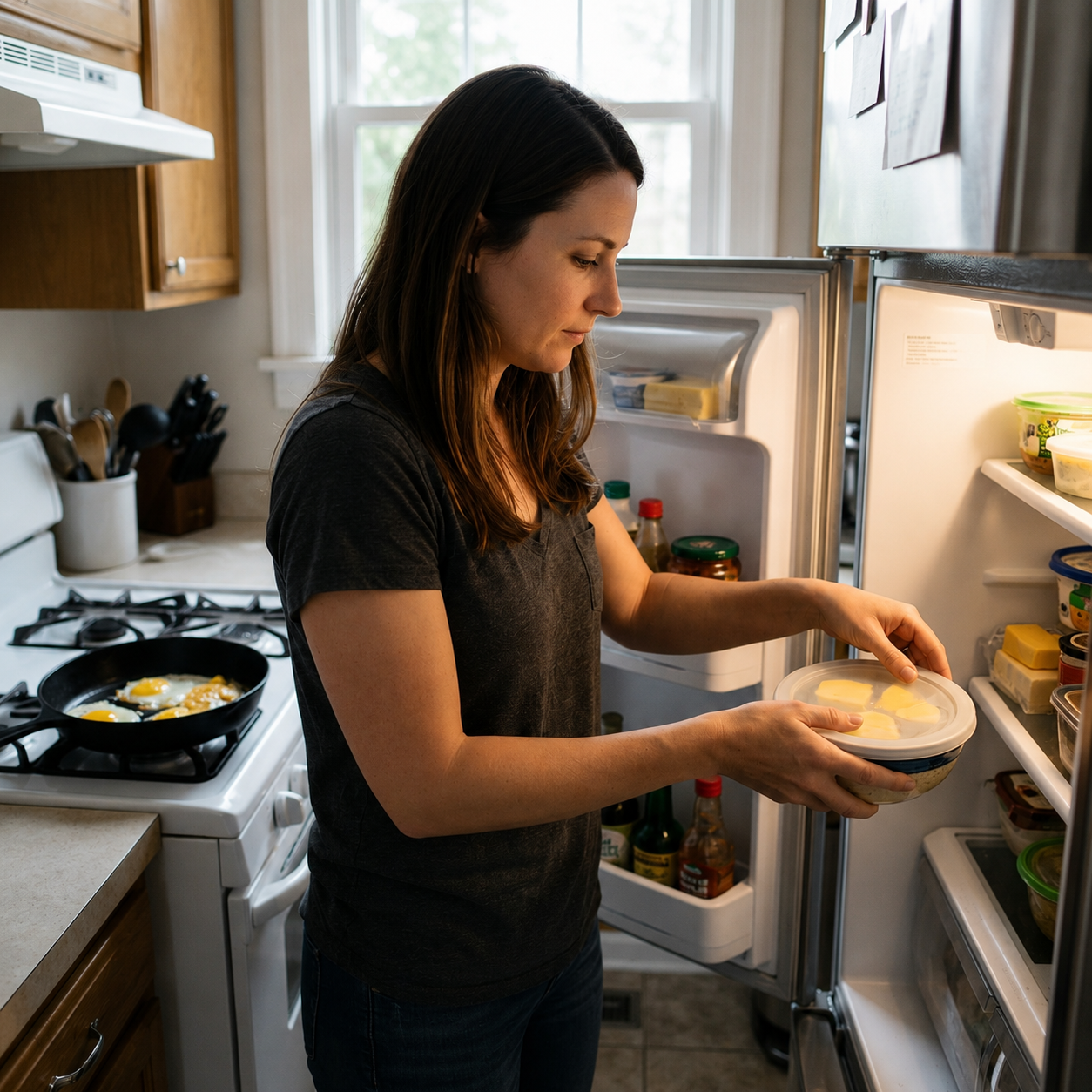
In simple terms, briefly pan-searing a piece if cheese or cooking eggs is unlikely to strip out their K2 content.
Oxygen Is One of The Reason
The same controlled stability study on MK-7 found that atmospheric oxygen accelerated the degradation of the biologically active all-trans form of the vitamin molecule, particularly when combined with heat.
This emphasizes more on how food is stored than it is cooked. Improper packaging or storing exposes the food to both oxygen and light simultaneously causing it to degrade.
A review on vitamin K forms in cheese showed that bacterial fermentation continues throughout the ripening process of the cheese. This means longer-aged cheeses can carry meaningfully different menaquinone profiles in comparison to the fresh ones, since the same bacteria responsible for the flavor development is also actively synthesizing K2 as the cheese matures.
K1 in Vegetables Works Differently
K2 and K1 behaves quite differently under heat.
A study testing blanching, boiling, microwaving and steaming across ten vegetables found that vitamin K retention varied depending on both the cooking method and the specific vegetable. Microwaving caused the greatest losses in some greens.
This inconsistency is a feature of K1’s presence in delicate plant tissue and not necessarily it is a pattern that also applies to the bacterially produced K2 found in fermented and animal-based foods, which tends to be more chemically stable once formed.
How to Store K2 Food
Keep all the K2-containing foods like cheese, natto, eggs yolks, etc sealed and in refrigerated condition rather than exposed on the kitchen counter.
Prefer opaque containers over clear containers.
Keep away from direct light exposure.
How TerraQuino Fits
TerraQuino manufactures Vitamin K2-7 (MK-7) through controlled fermentation with good stability and high purity, providing neutraceutical brands a stable, allergen-free ingredient designed to resist the light, oxygen and formulation-related degradation pathways.
It can be formulated around different formats including tablets, capsules, softgels, sachets and liquids. It gives brands a way to build formulations around the specific menaquinone form the research actually supports, rather than just a generic vitamin K blend.
Frequently Asked Questions
Does cooking cheese or eggs destroy their Vitamin K2 content?
Not significantly as research on menaquinone-7 (MK-7) shows that it is moderately heat-stable. Light and oxygen exposure plays a bigger role in its degradation than cooking temperature.
Should K2 containing food be stored in the fridge or can they be kept out?
Refrigeration in a sealed, light-blocking container is preferable because oxygen and temperature and not just temperature alone, are the primary drivers of K2 degradation.
Does aged cheese have more Vitamin K2 than a fresh cheese?
Yes, mostly. It is because bacterial fermentation continues during ripening of the cheese. So, aged cheeses can carry different, sometimes higher menaquinone profiles compared with fresh ones.
References
Lal, N., Seifan, M., & Berenjian, A. (2023). Fermentation of menaquinone-7: The influence of environmental factors and storage conditions on the isomer profile. Processes, 11(6), Article 1816. https://doi.org/10.3390/pr11061816
Lee, S., Choi, Y., Jeong, H. S., Lee, J., & Sung, J. (2018). Effect of different cooking methods on the content of vitamins and true retention in selected vegetables. Food Science and Biotechnology, 27(2), 333–342. https://doi.org/10.1007/s10068-017-0281-1
Orlando, P., Silvestri, S., Marcheggiani, F., Cirilli, I., & Tiano, L. (2019). Menaquinone-7 stability of formulations and its relationship with purity profile. Molecules, 24(5), Article 829. https://doi.org/10.3390/molecules24050829
Zhou, S., Mehta, B. M., & Feeney, E. (2022). A narrative review of vitamin K forms in cheese and their potential role in cardiovascular disease. International Journal of Dairy Technology, 75(4), 741–753. https://doi.org/10.1111/1471-0307.12901