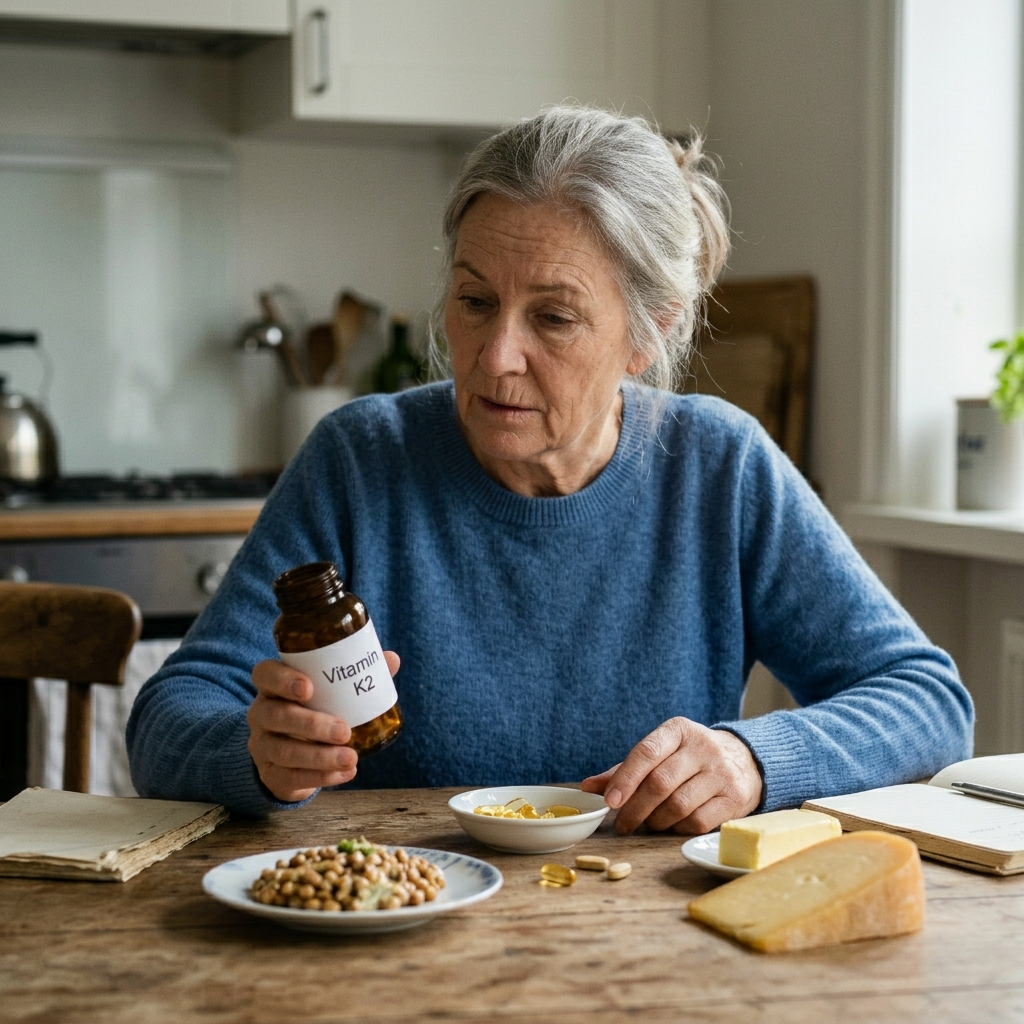
Vitamin K2 is moving towards becoming the latest “must-have” supplement. Over the past decade and a half, it went from just being in nutrition textbooks to a supplement-aisle and now is a growing health-trend. Much of this rise can be attributed to the social media marketing team and the wellness industry, which have brought Vitamin K2 into the spotlight.
However, with its growing popularity comes a wave of claims, misconceptions, and half-truths. Despite the increasing attention surrounding Vitamin K2, there are still several myths about its benefits, uses, and effectiveness that need to be examined and debunked.
Vitamin K at a Glance
Vitamin K is a group of fat-soluble compounds that your body needs for blood clotting and building healthy bones. Vitamin K comes in two families. K1 (phylloquinone) is made by plants and is what you get from leafy greens. K2 (menaquinones) is made by bacteria and shows up in fermented foods and animal tissue. Both share the same chemical head and differ in the side chain attached to it.
Side chain matters a lot as it determines how long the molecule stays in your bloodstream and which tissues it reaches. Menaquinones are named for the length of that chain. MK-4 has four isoprene units, MK-7 has seven, up to MK-13.
Vitamin K’s job is to switch on a group of proteins by adding a calcium-binding group to them. Two of those explain most of the interest in K2: Osteocalcin is involved in bone and Matrix Gla Protein blocks calcium from depositing in artery walls.
Myths Debunked
K1 and K2 do the same job
Even though they are from the same family but they don’t behave the same way in the body. A 2007 study in Blood compared equal doses of K1 and MK-7 and found MK-7 reached higher levels in serum, stayed there for days instead of hours and activated osteocalcin in a way that K1 at the same dose did not. The reason is that the liver clears K1 quickly, while MK-7 rides on lipoproteins long enough to reach tissue elsewhere.
Population data points the same way. In the Rotterdam Study, higher dietary menaquinone intake tracked with lower coronary heart disease mortality and less aortic calcification. Phylloquinone intake in the same group showed no such link.
Gut bacteria make all the K2 we need
Gut bacteria do produce menaquinones, and there are meaningful amounts in the large intestine. Getting them into the bloodstream is the problem. A review in Frontiers in Immunology summarised it that most of those menaquinones stay bound to bacterial membranes, general bioavailability is poor and a short-term drop in dietary vitamin K is not compensated by what bacteria make.
How much gets absorbed is still not settled. What’s clear is that you can’t treat gut production as a reliable substitute for diet.
Vitamin K2 thins the blood
Vitamin K helps blood clot. It doesn’t thin it. A routine supplement doses don’t appear to meaningfully alter how your blood clots anyway. For instance, a 2021 study in Medicine monitored 40 healthy adults taking 90 µg of daily MK-7 for 30 days. Throughout the trial, their vitamin K-dependent clotting factors and general clotting metrics stayed completely steady.
One exception is worth taking seriously. If you take warfarin, vitamin K intake interacts directly with the drug. The UD Office of Dietary Supplements advises people on warfarin to keep vitamin K intake consistent, because sudden changes can push the anticoagulant effect up or down. It’s an important conversation to have with your doctor if you’re on warfarin, but for everyone else, it’s not a reason to panic.
K2 clears calcium out of blocked arteries
This is the biggest stretch in the category. The most solid evidence we have comes from the June 2026 VitaK-CAC study in JAMA Cardiology, where 180 heart disease patients took 360 µg of MK-7 or a placebo for two years. In the result, calcium scores went up across the board. MK-7 didn’t miraculously clear out arteries; it just made the score climb a bit slower, from 135 to 184 Agatston units, compared to 145 to 214 for placebo.
Slower progression is not removal. Prior clinical trials yielded even weaker evidence. A 2022 Circulation study evaluating men with aortic valve calcification found no measurable effect, and a 2023 meta-analysis in Frontiers in Nutrition determined that Vitamin K2 has a limited impact on vascular calcification overall. Currently, no published clinical data demonstrates that K2 reverses established calcification or reduces cardiovascular events like heart attacks.
All MK-7 on the market is the same
MK-7 exists in different geometric forms, and only the all-trans configuration is biologically active. Cis isomers do not perform the same way as the trans isomers. The isomer profile of a finished product depends on how it was produced, purified and stored.
So, a label saying “100 µg MK-7” doesn’t tell you how much of that is usable. Always look for the all-trans percentage backed by a certificate of analysis.
Natto is the only real source of K2
Natto is so far the richest source, supplying roughly 850 µg of MK-7 per 3-ounce serving according to the Office of Dietary Supplements. But it isn’t the only supplement. Cheeses, other fermented food and animal foods contribute to menaquinones too. Cheddar sits around 4 µg per 1.5 ounce serving as MK-4.
So, if you don’t eat natto, you’re not getting zero. You’re getting considerably less.
More K2 is better
There’s no evidence for that. The clinical trials, and the doses are surprisingly modest: 90 µg for blood clotting, 180 µg for a multi-year bone density study in postmenopausal women, and 360 µg for arterial health. Nobody has ever proven that doubling or tripling these amounts does anything extra.
What’s Still Unsettled
Being honest about the gap is part of debunking.
No trial has shown that vitamin K2 reduces fractures or cardiovascular events, and whether a calcium score is even a good stand-in for clinical benefit is disputed. The clean “K1 for blood, K2 for bones” story is itself simplified, since the human enzyme UBIAD1 converts dietary K1 into MK-4 inside tissue.
K2 is a well-characterised cofactor with measurable effects on protein activation. It is not a decalcifier, and it isn’t a substitute for the things that actually move cardiovascular risk.
Frequently Asked Questions
Is vitamin K2 is safe to take every day?
For most healthy adults, the doses used in published trials (90–360 µg daily) have not shown safety problems, and a 30-day study at 90 µg found no change in clotting measures. People on warfarin or other vitamin K antagonists should speak to their doctor first.
Do I need K2 with Vitamin D3?
The combination may seem logical because vitamin K helps activate proteins involved in regulating where calcium is deposited in the body. But the idea that taking vitamin D3 on its own is inherently harmful isn’t strongly supported by evidence. In fact, a trial that combined K2 and vitamin D in men with aortic valve calcification found that the combination did not slow the progression of calcification. So, while the D3–K2 pairing makes biological sense, that doesn’t automatically mean everyone taking D3 needs to add K2.
How do I know if I’m low in vitamin K2?
There’s no routine test. Research uses a marker called dp-ucMGP, which rises when the vitamin K-dependent protein in artery walls isn’t being activated, but it isn’t part of standard clinical panels.
References
Diederichsen, A., Lindholt, J., Möller, S., Øvrehus, K. A., Auscher, S., Lambrechtsen, J., Hosbond, S., Alan, D., Urbonaviciene, G., Becker, S., Fredgart, M. H., Hasific, S., Folkestad, L., Gerke, O., Rasmussen, L., Møller, J., Mickley, H., & Dahl, J. (2022). Vitamin K2 and D in patients with aortic valve calcification: A randomized double-blinded clinical trial. Circulation, 145, 1387–1397. https://doi.org/10.1161/CIRCULATIONAHA.121.057008
Geleijnse, J., Vermeer, C., Grobbee, D., Schurgers, L., Knapen, M., van der Meer, I. M., Hofman, A., & Witteman, J. (2004). Dietary intake of menaquinone is associated with a reduced risk of coronary heart disease: The Rotterdam Study. The Journal of Nutrition, 134(11), 3100–3105. https://doi.org/10.1093/jn/134.11.3100
Knapen, M. H. J., Drummen, N. E., Smit, E., Vermeer, C., & Theuwissen, E. (2013). Three-year low-dose menaquinone-7 supplementation helps decrease bone loss in healthy postmenopausal women. Osteoporosis International, 24(9), 2499–2507. https://doi.org/10.1007/s00198-013-2325-6
Lai, Y., Masatoshi, H., Ma, Y., Guo, Y., & Zhang, B. (2021). Role of vitamin K in intestinal health. Frontiers in Immunology, 12, Article 791565. https://doi.org/10.3389/fimmu.2021.791565
Lal, N., & Berenjian, A. (2020). Cis and trans isomers of the vitamin menaquinone-7: Which one is biologically significant? Applied Microbiology and Biotechnology, 104(7), 2765–2776. https://doi.org/10.1007/s00253-020-10409-1
Li, T., Wang, Y., & Tu, W. (2023). Vitamin K supplementation and vascular calcification: A systematic review and meta-analysis of randomized controlled trials. Frontiers in Nutrition, 10, Article 1115069. https://doi.org/10.3389/fnut.2023.1115069
Nakagawa, K., Hirota, Y., Sawada, N., Yuge, N., Watanabe, M., Uchino, Y., Okuda, N., Shimomura, Y., Suhara, Y., & Okano, T. (2010). Identification of UBIAD1 as a novel human menaquinone-4 biosynthetic enzyme. Nature, 468(7320), 117–121. https://doi.org/10.1038/nature09464
National Institutes of Health, Office of Dietary Supplements. (n.d.). Vitamin K: Fact sheet for health professionals. https://ods.od.nih.gov/factsheets/VitaminK-HealthProfessional/
Ren, R., Liu, J., Cheng, G., & Tan, J. (2021). Vitamin K2 (menaquinone-7) supplementation does not affect vitamin K-dependent coagulation factors activity in healthy individuals. Medicine, 100(23), Article e26221. https://doi.org/10.1097/MD.0000000000026221
Schurgers, L., Teunissen, K., Hamulyák, K., Knapen, M., Vik, H., & Vermeer, C. (2007). Vitamin K-containing dietary supplements: Comparison of synthetic vitamin K1 and natto-derived menaquinone-7. Blood, 109(8), 3279–3283. https://doi.org/10.1182/blood-2006-08-040709
Shiraki, M., Shiraki, Y., Aoki, C., & Miura, M. (2000). Vitamin K2 (menatetrenone) effectively prevents fractures and sustains lumbar bone mineral density in osteoporosis. Journal of Bone and Mineral Research, 15(3), 515–521. https://doi.org/10.1359/jbmr.2000.15.3.515
Vossen, L. M., de Leeuw, P., Schurgers, L., Heuts, S., Adriaans, B., de Haan, C., van Varik, B., & Kroon, A. A. (2026). Two years of menaquinone-7 supplementation and coronary artery calcification: A randomized clinical trial. JAMA Cardiology. Advance online publication. https://doi.org/10.1001/jamacardio.2026.1279