Vitamin K is a group of fat-soluble compounds essential for blood clotting and healthy bone metabolism. Vitamin K comes in two families:
K1 (phylloquinone): made by plants; leafy greens are the main source.
K2 (menaquinones): made by bacteria and found in fermented food.
Menaquinones are named by the length of their side chains: MK-4, MK-7, MK-9, and so on. It is the side chain that decides how long the vitamin stays in the blood and which tissues it can reach.
Vitamin K switches on certain proteins by adding a calcium-binding group to them. Osteocalcin and Matrix Gla Protein is of the most interest. Osteocalcin is activated by Vitamin K2 to help bind and deposit calcium into the bone matrix. Whereas Matrix Gla Protein is activated by Vitamin K2 to prevent calcium buildup in soft tissues and blood vessel walls.
K2 Dosage: A buyer should stay close to the doses that have been tested. Published human trials of MK-7 sit between about 90 µg and 360 µg a day. Above that range there is little to go on. A capsule offering 1,000 µg is not offering more evidence.
MK-4 vs MK-7
| Feature | MK-4 (Menaquinone-4) | MK-7 (Menaquinone-7) |
| Side Chain | Short chain with 4 isoprene units | Long chain with 7 isoprene units |
| Half-Life | Short-acting; cleared from blood in about 6–8 hours | Long-acting; remains active in blood for several days |
| Typical Dosage | Milligram (mg) range; often 45 mg/day in clinical trials for bone density | Microgram (mcg) range; typically 100–200 mcg once daily |
| Dosing Frequency | Requires frequent/multiple daily doses to maintain levels | Effective with a convenient once-daily dose |
| Natural Sources | Animal products such as meat, eggs, and butter | Fermented foods such as natto (fermented soybeans) and some hard cheeses |
| Body Transport | Packaged into triglyceride-rich particles and cleared relatively quickly | Associated with cholesterol/lipoproteins, allowing longer circulation |
Bioavailability and Absorption
At the same dose, MK-7 reached higher blood levels than K1, stayed there for days rather than hours, and activated osteocalcin in a way K1 did not. Additionally, vitamin K is a fat-soluble vitamin, so its absorption improves when taken with a meal containing some fat. This is why oil-based softgels have a head start over dry powder for the same reason.
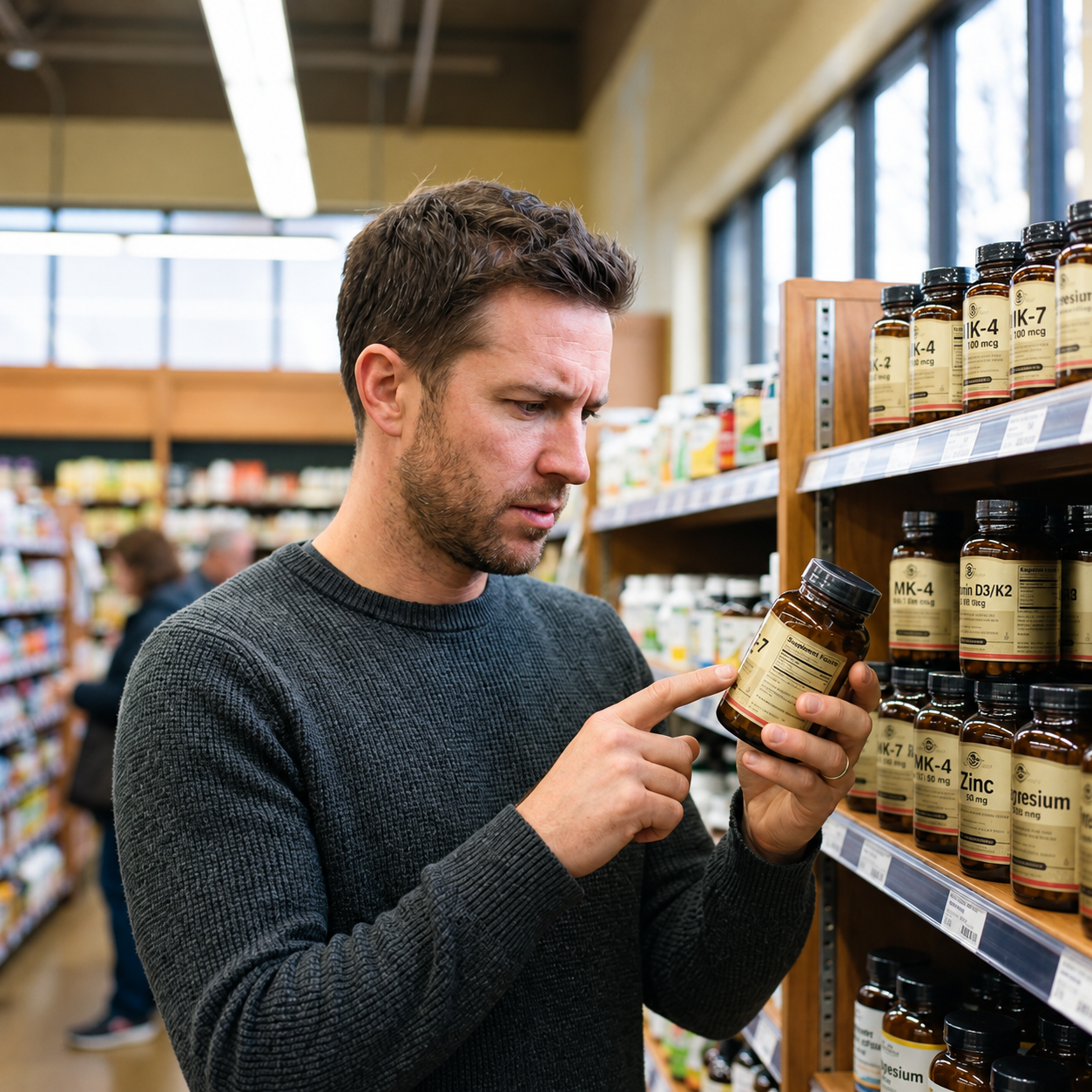
Reading a K2 Supplement Label
When checking a vitamin K2 supplement, look at four important things:
- Exact form: Check whether the label specifies MK-4 or MK-7. A label that only says “vitamin K2” does not tell you which form it contains.
- Amount: Check the amount in micrograms (µg) and make sure you know whether it is listed per capsule or per serving.
- Source: Look for information about where the K2 comes from, such as fermentation using Bacillus subtilis.
- All-trans: If the label mentions “all-trans,” take note of it, especially for MK-7 products.
These details can help you understand exactly what type and amount of vitamin K2 the supplement provides.
Quality of the Ingredient
This is actually the crucial point which many consumers overlook. MK-7 comes in various geometrical arrangements, but only all-trans MK-7 is biologically active. A label cannot tell them apart. When researchers analysed MK-7 products on the market, some contained only 5% to 55% of the MK-7 declared on the label, and the shortfall lined up with a poorer purity profile (Orlando et al., 2019). Buyers should look for all-trans percentage.
Additionally, a certificate of analysis from the manufacturer tells what one batch contained. Independent verification is stronger. Check whether testing covers identity and potency, and whether potency was confirmed at the end-of-shelf-life rather than only at manufacture. Programmes such as USP Verified and NSF certification show that someone outside the company has checked the material.
What Else Is in The Supplement
The other ingredients in a supplement can also affect the stability of K2. One study found that calcium citrate and calcium carbonate kept MK-7 mostly stable for 12 months, while magnesium oxide caused significant degradation. The breakdown was even greater when the supplement was exposed to higher temperatures and humidity (Orlando et al., 2019).
So, a supplement containing magnesium oxide along with MK-7 may gradually lose some of its potency during storage.
On the other hand, combining vitamin K2 and vitamin D makes biological sense because vitamin K helps activate proteins involved in regulating calcium in the body. However, the evidence that taking both together provides an extra benefit is still limited.
For example, a study in men with aortic valve calcification found that taking K2 and vitamin D together did not slow the progression of calcification (Diederichsen et al., 2022).
If you choose a combination supplement, check the label to make sure the amount of vitamin K2 and vitamin D is clearly listed separately.
Regulations and Safety
In India, health supplements fall under the Food Safety and Standards (Health Supplements, Nutraceuticals, Food for Special Dietary Use, Food for Special Medical Purpose, Functional Food and Novel Food) Regulations, 2016. Vitamin K2 appears in Schedule I, the list of permitted vitamins and minerals and their approved chemicals forms. The amount of each nutrient must be declared on the label, and the pack must carry the FSSAI licence number (FSSAI, 2021).
The US Office of Dietary Supplements advises people on warfarin to keep vitamin K intake from food and supplements steady, because sudden changes shift the drug’s effect.
K2 Supplement Buyer’s Checklist
Before buying a vitamin K2 supplement, check these points:
- Form: The label should clearly mention MK-7 or MK-4, not just “vitamin K2.”
- Dose: For MK-7, check whether the dose falls within the 90–360 µg range used in studies.
- All-trans: Look for “all-trans” and, ideally, the percentage stated on the label.
- Certificate of analysis: The manufacturer should be able to provide a certificate confirming the product’s identity and potency.
- Shelf-life testing: Check whether potency has been tested at the end of the product’s shelf life, not only when it was manufactured.
- Other ingredients: Avoid formulas containing magnesium oxide if stability of MK-7 is a concern.
- Source: Look for information about the fermentation source used to produce K2.
- Labelling: Check for an FSSAI licence number and a complete nutrient declaration on the package.
- Health claims: Be cautious of products claiming to reverse or remove calcification, as such claims go beyond the evidence.
How TerraQuino Fits
TerraQuino supplies vitamin K2-7 (MK-7) as an ingredient to nutraceutical brands rather than selling finished bottles. The ingredient is produced by a controlled fermentation process, supplied allergen-free, and used in tablets, capsules, softgels, sachets and liquids.
For brands formulating supplements or related products, TerraQuino provides a practical way to build the kind of combined nutrient.
References
Diederichsen, A., Lindholt, J., Möller, S., Øvrehus, K. A., Auscher, S., Lambrechtsen, J., Hosbond, S., Alan, D., Urbonaviciene, G., Becker, S., Fredgart, M. H., Hasific, S., Folkestad, L., Gerke, O., Rasmussen, L., Møller, J., Mickley, H., & Dahl, J. (2022). Vitamin K2 and D in patients with aortic valve calcification: A randomized double-blinded clinical trial. Circulation, 145, 1387–1397. https://doi.org/10.1161/CIRCULATIONAHA.121.057008
Food Safety and Standards Authority of India. (2021). Compendium of Food Safety and Standards (Health Supplements, Nutraceuticals, Food for Special Dietary Use, Food for Special Medical Purpose, Functional Food and Novel Food) Regulations, 2016. https://fssai.gov.in/upload/uploadfiles/files/Compendium_Nutra_29_09_2021.pdf
Knapen, M. H. J., Drummen, N. E., Smit, E., Vermeer, C., & Theuwissen, E. (2013). Three-year low-dose menaquinone-7 supplementation helps decrease bone loss in healthy postmenopausal women. Osteoporosis International, 24(9), 2499–2507. https://doi.org/10.1007/s00198-013-2325-6
Lal, N., & Berenjian, A. (2020). Cis and trans isomers of the vitamin menaquinone-7: Which one is biologically significant? Applied Microbiology and Biotechnology, 104(7), 2765–2776. https://doi.org/10.1007/s00253-020-10409-1
Li, T., Wang, Y., & Tu, W. (2023). Vitamin K supplementation and vascular calcification: A systematic review and meta-analysis of randomized controlled trials. Frontiers in Nutrition, 10, Article 1115069. https://doi.org/10.3389/fnut.2023.1115069
National Institutes of Health, Office of Dietary Supplements. (n.d.). Vitamin K: Fact sheet for health professionals. Retrieved September 19, 2026, from https://ods.od.nih.gov/factsheets/VitaminK-HealthProfessional/
Orlando, P., Silvestri, S., Marcheggiani, F., Cirilli, I., & Tiano, L. (2019). Menaquinone 7 stability of formulations and its relationship with purity profile. Molecules, 24(5), Article 829. https://doi.org/10.3390/molecules24050829
Ren, R., Liu, J., Cheng, G., & Tan, J. (2021). Vitamin K2 (menaquinone-7) supplementation does not affect vitamin K-dependent coagulation factors activity in healthy individuals. Medicine, 100(23), Article e26221. https://doi.org/10.1097/MD.0000000000026221
Schurgers, L., Teunissen, K., Hamulyák, K., Knapen, M., Vik, H., & Vermeer, C. (2007). Vitamin K-containing dietary supplements: Comparison of synthetic vitamin K1 and natto-derived menaquinone-7. Blood, 109(8), 3279–3283. https://doi.org/10.1182/blood-2006-08-040709
Shiraki, M., Shiraki, Y., Aoki, C., & Miura, M. (2000). Vitamin K2 (menatetrenone) effectively prevents fractures and sustains lumbar bone mineral density in osteoporosis. Journal of Bone and Mineral Research, 15(3), 515–521. https://doi.org/10.1359/jbmr.2000.15.3.515
Vossen, L. M., de Leeuw, P., Schurgers, L., Heuts, S., Adriaans, B., de Haan, C., van Varik, B., & Kroon, A. A. (2026). Two years of menaquinone-7 supplementation and coronary artery calcification: A randomized clinical trial. JAMA Cardiology. Advance online publication. https://doi.org/10.1001/jamacardio.2026.1279