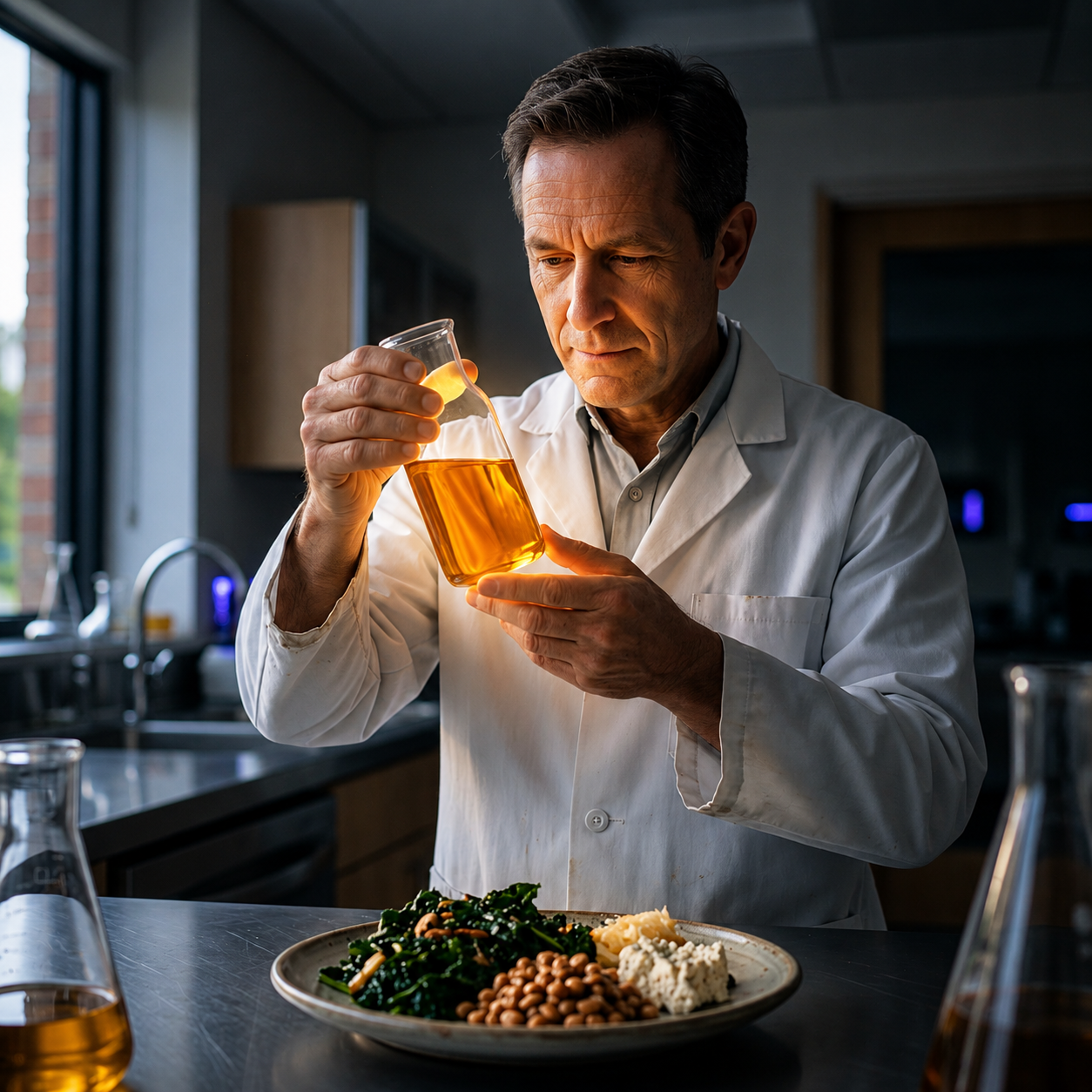
Trillions of bacteria live in the human colon, and a fair number of them spend part of their day manufacturing a nutrient most people assume only comes from natto, cheese, or a capsule. This quiet bit of bacterial chemistry rarely makes it into supplement marketing, probably because it complicates the pitch that if gut bacteria are already making Vitamin K2, why would anyone need more of it?
The honest answer is more interesting than a simple yes or no, and it says a lot about why K2 status varies so much from person to person.
Yes, Gut Bacteria Really Do Make K2
Menaquinones, the chemical family that makes up Vitamin K2, are produced as a side effect of energy metabolism in certain bacteria, not something humans manufacture on their own.
A 2023 laboratory analysis that screened 86 bacterial strains isolated from the human intestine found that Lactobacillus, Bifidobacterium, and Bacillus species were the most prolific producers of long-chain menaquinones such as MK-7 and MK-9 (Smajdor et al., 2023).
Separately, metagenomic sequencing of the human gut microbiome has confirmed that bacteria from the Firmicutes, Actinobacteria, and Bacteroidetes phyla all carry the genetic pathway for menaquinone biosynthesis (Dash & Al Bataineh, 2021).
Making It and Using It Are Different Things
One of the earliest direct human studies on this topic placed bacterially produced menaquinone into the distal ileum of volunteers and confirmed it could be absorbed from that specific location, offering real evidence that gut-derived K2 can reach circulation (Conly et al., 1994). But most menaquinone-producing bacteria live much further down, in the colon, a region generally considered less efficient for absorbing a fat-soluble nutrient than the small intestine.
A more recent study measured this gap directly. Researchers tracked fecal concentrations of bacterially derived vitamin K forms in healthy adults and found they were strongly associated with the composition of a person’s gut microbiota, as expected, but not associated with plasma vitamin K levels (Karl et al., 2017).
In plain terms, your gut bacteria may well be producing menaquinones, and a stool sample could even confirm it, without that production reliably showing up in your bloodstream. Production and absorption are two separate steps, and the second one is not guaranteed.
Why This Varies From Person to Person
Microbiome composition is not static. It is rather dynamic and influenced by various factors, such as diet, age, antibiotics, and presence of certain diseases. All these factors impact the number of bacterial species capable of menaquinone production. As for the metagenomic study on type 2 diabetes, researchers noted the presence of a distinct pathway of menaquinone synthesis in patients with the condition as opposed to healthy people (Dash & Al Bataineh, 2021).
A course of broad-spectrum antibiotics can just as easily do the opposite, reducing the very bacterial populations responsible for this synthesis. None of this shows up on a food label, which is part of why it stays overlooked.
What This Means in Practical Terms
K2 produced from the gut is authentic but variable, colon-dependent, and rather distantly linked to what will wind up in circulation and be needed by MGP and osteocalcin. This doesn’t mean that the microbiome is irrelevant but rather means we can’t depend on it as our sole or certain source, especially for those concerned with bone density, cardiovascular well-being, or guts impacted by antibiotics, aging, or chronic disease. That is why dietary and supplemental K2 sources, such as the highly bioavailable long-chain K2 form of MK-7, make up for this deficit.
How TerraQuino Fits
TerraQuino manufactures Vitamin K2-7 (MK-7) using a controlled, standardized fermentation process built specifically to produce a consistent, allergen-free ingredient for nutraceutical brands.
Where gut bacteria offer an unpredictable, colon-based supply that studies show does not reliably reach the bloodstream, TerraQuino’s fermentation-derived MK-7 is designed for stability and dependable bioavailability, giving formulators a way to deliver the long-chain menaquinone form research keeps pointing to as the most usable by the human body.
For brands building bone or heart health products, that consistency, tablet to tablet and batch to batch, is exactly what bacterial gut synthesis alone cannot promise.
Frequently Asked Questions
Can I rely on gut bacteria alone for enough Vitamin K2?
Not reliably. Bacterially derived K2 is dependent on the composition of gut microflora but does not correlate with the level of vitamin K in blood plasma, which means the production is not guaranteed to be accompanied by the uptake.
Which gut bacteria actually produce Vitamin K2?
The laboratory evaluation of strains of intestinal bacteria revealed Lactobacillus, Bifidobacterium, and Bacillus genera as the top menaquinone producers among tested ones.
Do antibiotics affect gut-based K2 production?
Yes, possibly. As the process of menaquinone synthesis requires certain bacterial strains, any disturbance of the microbiome such as the intake of broad-spectrum antibiotics may result in reduced levels of this vitamin.
Should I still take a K2 supplement if I eat a healthy, fiber-rich diet?
Having a good diet is beneficial for the general condition of the microbiome, yet it cannot provide with sufficient amounts of bacterially synthesized K2. People tend to use MK-7 directly for this purpose.
References
Conly, J. M., Stein, K., Worobetz, L., & Rutledge-Harding, S. (1994). The contribution of vitamin K2 (menaquinones) produced by the intestinal microflora to human nutritional requirements for vitamin K. American Journal of Gastroenterology, 89(6), 915–923.
Dash, N. R., & Al Bataineh, M. T. (2021). Metagenomic analysis of the gut microbiome reveals enrichment of menaquinones (vitamin K2) pathway in diabetes mellitus. Diabetes & Metabolism Journal, 45(1), 77–85. https://doi.org/10.4093/dmj.2019.0202
Karl, J. P., Meydani, M., Barnett, J. B., Vanegas, S. M., Barger, K., Fu, X., Goldin, B., Kane, A., Rasmussen, H., Vangay, P., Knights, D., Jonnalagadda, S. S., Saltzman, E., Roberts, S. B., Meydani, S. N., & Booth, S. L. (2017). Fecal concentrations of bacterially derived vitamin K forms are associated with gut microbiota composition but not plasma or fecal cytokine concentrations in healthy adults. American Journal of Clinical Nutrition, 106(4), 1052–1061. https://doi.org/10.3945/ajcn.117.155424
Smajdor, J., Jedlińska, K., Porada, R., Górska-Ratusznik, A., Policht, A., Śróttek, M., Więcek, G., Baś, B., & Strus, M. (2023). The impact of gut bacteria producing long chain homologs of vitamin K2 on colorectal carcinogenesis. Cancer Cell International, 23, Article 268. https://doi.org/10.1186/s12935-023-03114-2