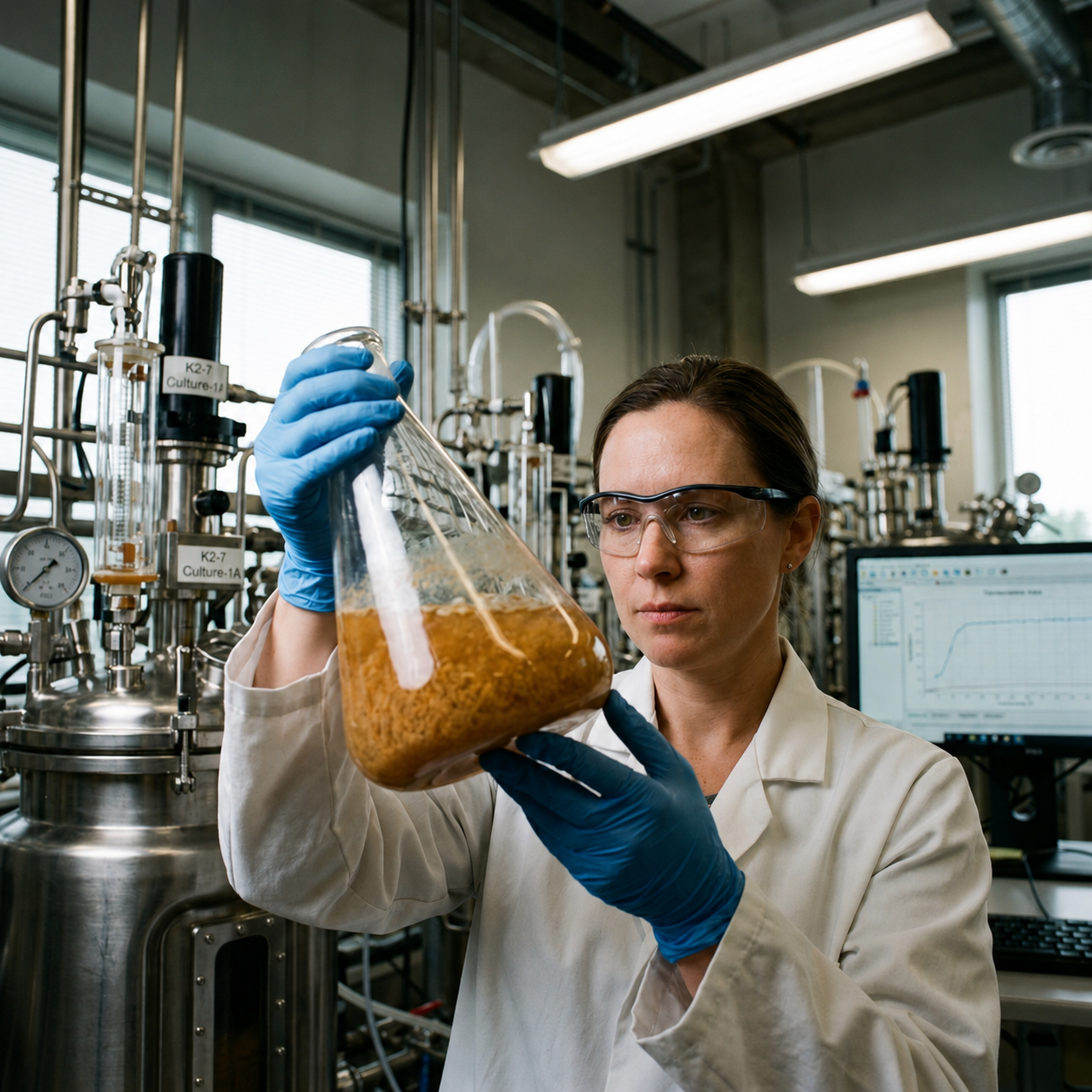
Not all vitamin K is created equal. The difference starts long before it reaches the consumer. Unlike older forms of vitamin K made in chemical labs or pulled from raw plant matter, today’s Vitamin K2-7 is cultured through advanced bacterial fermentation, making it cleaner, more stable, and vastly more effective.
In 2024, Balchem and Alkemist Labs bought 38 vitamin K2 supplements online and tested what was actually inside. 71% failed, either on how much MK-7 they contained or on whether that MK-7 was the right shape (Neutraceuticals World, 2024).
Only eleven products out of thirty-eight passed.
The main reason for this failure was just the wrong version of the molecule K2. This thing then completely comes down to how the raw material was manufactured in the first place. Production decides the shape of the molecule, the size of the dose, how long the product survives on a shelf, and whether any of it reaches your bloodstream.
All vitamin K molecules share one component i.e. a ring structure called a naphthoquinone. That ring does the actual work of switching on proteins that directs calcium in bone and keep it out of the artery walls. What differs in K2 molecule is the tail hanging off the ring. Vitamin K1, phylloquinone, has one long tail with only one double bond in it. Vitamin K2 comes as a family of menaquinones named for how many isoprene units their tail contains. MK-4 has four tails while MK-7 has seven.
Vitamin K1 has been made by chemical synthesis since the 1940s. It works, it’s cheap, and it’s been in vitamin K injections and multivitamins for decades. MK-4 is also chemically synthesised. Its usual starting point is menadione, sometimes called vitamin K3, which is the bare naphthoquinone ring with no tail at all. Manufacturers build the four-unit tail onto it. MK-7 form is usually labelled K2-7. It is grown, not built. Bacillus subtilis natto, the bacterium behind the Japanese fermented soybean dish natto, produce MK-7 as part of its own metabolism. Commercial production is fermentation i.e. feed the bacteria, let them do the work and then just extract what they made.
Menadione
Menadione is a vitamin K precursor, but it was stopped from being used to treat vitamin K deficiency in humans after cases of liver toxicity, jaundice and hemolytic anemia in infants. It also interferes with glutathione, one of the body’s own antioxidants (Linus Pauling Institute, 2024). It remains a standard additive in animal feed, where it works fine.
Finished MK-4 is not menadione. They are different molecules, and there is no evidence that taking MK-4 as a supplement causes the same concerns associated with menadione. The main difference is where they come from. MK-4 is produced through a synthesis process that starts with a compound that humans no longer take directly, while MK-7 can be produced by bacteria similar to those traditionally consumed in natto for around a thousand years. Both MK-4 and MK-7 can be good vitamin K2 products, but their sources and production methods are very different, which is why they are viewed differently in the market.
The Issue with Shape
A molecule with double bonds in its tail can form two geometries called cis and trans. For vitamin K, only the all-trans form does the job. Cis-form vitamin K has roughly 1% of the biological activity. Bacterial enzymes are shape-specific by nature, and fermentation produces MK-7 in the all-trans configuration. Chemistry plays a crucial role here as depending on the synthesis method, chemical production of MK-7 yields a trans-to-cis ratio around 1:2 or 1:3.
When commercial supplements were analysed, it was found that cis content ratio exceeded all-trans by up to 3.7 times. All-trans MK-7 ranged from 5.5 to 248.1 micrograms per pill. (Szterk etal., 2018).
Where It Goes Wrong
Purified synthetic MK-7 can also be a high-quality product. For example, Balchem’s K2VITAL is reported to contain 99.7% all-trans MK-7. The important issue is therefore not whether MK-7 is made synthetically, but how pure the final product is. A study that highlighted concerns about MK-7 isomers was conducted by Balchem, which produces synthetic MK-7 (NutraIngredients, 2024). The point was not that synthetic MK-7 is bad, but that poorly purified synthetic MK-7 may contain unwanted isomers. In other words, the concern is with unpurified synthesis, not synthesis itself.
An Italian stability study showed a similar result. When different MK-7 raw materials were compared, a fermented product from Gnosis contained 99.3% all-trans MK-7, another fermented product contained 93.7%, while Kappa’s synthetic MK-7 contained 92.7% (Orlando et al., 2019). This shows that the difference in purity is not simply between fermented and synthetic MK-7. Even products made through fermentation can vary considerably in quality, with differences between fermented products being almost as large as the difference between fermented and synthetic products.
So, the real dividing line runs between purified and unpurified, and between suppliers who test isomer ratios and suppliers who don’t. Fermentation keeps you closer to the finish line.
Compare the Labels
A Japanese MK-4 prescription is measured in tens of milligrams. A K2-7 supplement is measured in micrograms, usually 90 to 180. That’s a difference of several hundred-fold for two molecules whose only structural difference is tail length.
The explanation to this is absorption. When Japanese researchers gave healthy women a single 420-microgram dose of MK-4, it was undetectable in serum at every time point. A week of 60-micrograms daily did nothing either. MK-7 at the same doses was absorbed reliably, peaked at six hours, and was still measurable two days later (Sato et al., 2012). Look at a vitamin K label and you can trace back to the factory. Micrograms means MK-7 from fermentation. Milligrams means MK-4 from a synthesis line.
What Happens After Manufacturing
Raw material purity turns out to predict what happens in the finished product.
MK-7 can be sensitive to the other ingredients around it. In the Italian stability study, magnesium oxide caused significant instability in some MK-7 formulations. L-arginine had an even stronger effect, reducing the MK-7 content by about 50% within one month under normal storage conditions in one synthetic formulation. The study also found that raw materials containing more unidentified impurities tended to degrade faster. In some cases, the final products retained only about 5% of the amount stated on the label (Orlando et al., 2019).
The Balchem testing found something similar that only 8% of products using unprotected K2 alongside other ingredients still met label claim after three months (Neutraceuticals World, 2024).
MK-7 is more affected by this issue partly because of the very small amount used in supplements. MK-7 is usually present in microgram quantities, while calcium and magnesium may be present in much larger amounts, often in grams. Therefore, even a small loss of MK-7 can represent a large percentage of the original amount. This is one reason why microencapsulation, which protects each MK-7 particle from direct contact with minerals, has become a common approach for MK-7 supplements rather than simply an optional improvement.
Yield Uncertainty
Fermentation has one weakness and that is yield.
Wild-type B. subtilis in a biofilm reactor produces around 12 mg of MK-7 per litre. Genetically engineered strains have pushed that past 410 mg per litre in the lab (Zhang et al., 2021). Chemistry doesn’t face that problem as once a synthesis route works, it scales predictably.
So, fermentation gives the correct isomer and a food-derived process while chemistry gives you yield and consistency.
Where TerraQuino Fits
TerraQuino manufactures Vitamin K2-7 (MK-7) through controlled fermentation with good stability and high purity, providing neutraceutical brands a stable, allergen-free ingredient designed to resist the light, oxygen and formulation-related degradation pathways.
It can be formulated around different formats including tablets, capsules, softgels, sachets and liquids. It gives brands a way to build formulations around the specific menaquinone form the research actually supports, rather than just a generic vitamin K blend.
Frequently Asked Questions
Is fermented K2-7 always better than synthetic?
Not automatically. Fermentation guarantees the all-trans form, which is a good head start. But purified synthetic MK-7 can reach 99.7% all-trans form while fermentation all-trans ratio is somewhere in between 93.7% to 99.3%. Isomer ratio data matters more here and not just the category of the label.
What does “all-trans” on a label actually mean?
The all-trans form is the form with the desired biological activity, while the cis form has been reported to have only about 1% of the biological activity of the trans form. So, if a product contains a large amount of the cis form, the actual amount of biologically useful MK-7 can be much lower than the number shown on the label.
Why is MK-7 dosed in milligrams and MK-4 in micrograms?
It is because MK-4 barely shows up in blood at food-level or supplement-level doses that is why it is needed in more quantity in comparison to MK-7.
Reference
Giri, T. K., Newton, D., Chaudhary, O., Deych, E., Napoli, N., Villareal, R., Diemer, K., Milligan, P. E., & Gage, B. F. (2020). Maximal dose-response of vitamin-K2 (menaquinone-4) on undercarboxylated osteocalcin in women with osteoporosis. International Journal for Vitamin and Nutrition Research. https://doi.org/10.1024/0300-9831/a000554
Linus Pauling Institute. (2024). Vitamin K. Micronutrient Information Center, Oregon State University. https://lpi.oregonstate.edu/mic/vitamins/vitamin-K
Nutraceuticals World. (2024, August). Balchem and Alkemist Labs uncover quality issues with vitamin K2 supplements purchased online. https://www.nutraceuticalsworld.com/breaking-news/balchem-and-alkemist-labs-uncover-quality-issues-with-vitamin-k2-supplements-purchased-online/
Nutraingredients. (2024, August 14). Balchem-Alkemist analysis reveals vitamin K2 supplement quality concerns. https://www.nutraingredients.com/Article/2024/08/14/Balchem-Alkemist-analysis-reveals-vitamin-K2-supplement-quality-concerns/
Orlando, P., Silvestri, S., Marcheggiani, F., Cirilli, I., & Tiano, L. (2019). Menaquinone 7 stability of formulations and its relationship with purity profile. Molecules, 24(5), 829. https://doi.org/10.3390/molecules24050829
Sato, T., Schurgers, L. J., & Uenishi, K. (2012). Comparison of menaquinone-4 and menaquinone-7 bioavailability in healthy women. Nutrition Journal, 11(1), 93. https://doi.org/10.1186/1475-2891-11-93
Scientific Committee on Consumer Safety. (2010). Opinion on vitamin K1 (phytonadione) (SCCS/1313/10). European Commission. https://ec.europa.eu/health/scientific_committees/consumer_safety/docs/sccs_o_014.pdf
Szterk, A., Zmysłowski, A., & Bus, K. (2018). Identification of cis/trans isomers of menaquinone-7 in food as exemplified by dietary supplements. Food Chemistry. National Medicines Institute, Warsaw. https://www.sciencedirect.com/science/article/abs/pii/S0308814617316308
Zhang, Z., Liu, L., Liu, C., Sun, Y., & Zhang, D. (2021). New aspects of microbial vitamin K2 production by expanding the product spectrum. Microbial Cell Factories, 20, 84. https://doi.org/10.1186/s12934-021-01574-7