A team of American nutrition researchers once performed an experiment in which they fed 80 healthy adults a controlled diet for eight days, then measured vitamin K2 presence in their stool and in their blood.
The stool results came out to be spectacular. The participants were excreting a median of 850 nanomoles of menaquinones (vitamin K2) every day, with some producing more than six times that amount (Karl et al., 2017). In other words, the bacteria in the gut were making large amounts of vitamin K2.
But when the researchers looked at the blood, the result showed up very different as menaquinones were not detected in the participants’ serum.
So, the gap or key point is simple that gut bacteria can definitely produce vitamin K2, but that does not always means that the body is absorbing it as well. Moving it from the colon into circulation is a separate problem.
Two Vitamins, Same Name
Vitamin K1, phylloquinone, is the one in spinach, kale and broccoli. It is absorbed in body, then routed largely to the liver, and spent on blood clotting. Plant-based diets are usually full of it.
Vitamin K2, the menaquinone family labelled MK-4 through MK-13, behaves differently. It stays in the bloodstream for longer time and reaches tissues outside the liver, where further two proteins depend on it. Osteocalcin binds calcium into bone. Matrix Gla Protein stops calcium settling in artery walls. Both are manufactured in inactive form and need vitamin K to switch on.
A diet can therefore look rich in vitamin K on a nutrition label and still leave those two jobs unfinished.
The Usual Story Might Be Wrong
The usual story goes like vitamin K2 in present in liver, egg yolk, butter and cheese, so vegans miss out on the vitamin. But half of this is wrong.
Most of the K2 in meat, eggs and poultry is MK-4. In 2012, Japanese researchers tested what MK-4 actually does once it is ingested. Healthy women took a single 420-microgram dose, far more than any meal delivers. MK-4 was undetectable in their serum at every time point. A week of 60 micrograms a day did nothing either. MK-7 given at the same doses was absorbed reliably, peaked at six hours, and was still measurable two days later (Sato et al., 2012).
The authors concluded that dietary MK-4 does not contribute to vitamin K status as measured in blood. Now that reframes the question. The animal foods usually credited for solving the K2 problem mostly carry the form of the vitamin that barely registers. The foods that reliably raise circulating K2 are fermented ones.
Natto which is basically soybean fermented with Bacillus subtilis, contains roughly about 902 micrograms of MK-7 per 100 grams, and it is the richest source measured in any food (Tarvainen et al., 2019). Aged cheeses carry 282 to 506 micrograms of total vitamin K per 100 gram, mostly long-chain MK-9 to MK-11, and the amount tracks fat content closely enough that low-fat versions lose most of it (Fu et al., 2017). Chinese and Korean fermented soybean pastes contribute smaller but real amounts (Tarvainen et al., 2019).
The fine line runs between fermented and unfermented food, not between plants and animals. Vegans hit that line because they give up the two accidental sources most Western diets still contain, aged cheese and full-fat dairy, without picking up natto, which almost nobody outside Japan eats voluntarily.
Plant-based eaters consume more vitamin K than omnivores.
In a Spanish study of 301 adults, vegans had the highest vitamin K intake of the three diet groups. They also had higher parathyroid hormones and higher N-telopeptides (a marker of bone being actively broken down) than the omnivore (Garcia-Maldonado et al., 2024).
The bigger picture points the same. EPIC-Oxford tracked 54,898 UK adults for an average of 17.6 years. Vegans had 43% more total fractures and more than double the rate of hip fractures compared with meat-eaters, which works out to about 20 extra fractures per 1,000 vegans over a decade. Adjusting for calcium and protein intake narrowed the gap without closing it, and the authors concluded that factors they had not measured were probably involved (Tong et al., 2020).
Vitamin K2 was one of the things they had not measured. That does not make it the answer. It makes it a suspect nobody has ruled out.
Does K2 actually change outcomes?
For an honest answer, the observational evidence is strong while trial evidence is young.
The Rotterdam Study followed 4,807 Dutch adults from the early 1990s to 2000. Those in the highest third of menaquinone intake had a 57% lower rate of death from coronary heart disease and roughly half the odds of severe aortic calcification. Phylloquinone intake in the green vegetable form showed no association with any outcome (Geleijnse et al., 2004). A separate cohort of 16.057 Dutch women found the same direction, with the effect concentrated in the long-chain forms MK-7, MK-8 and MK-9 (Gast et al., 2009).
A 2021 review noted that these associations had not been confirmed by intervention trials and that enthusiasm had run ahead of evidence (Shea et al., 2021). Fair criticism at the time. This year, a randomised trial gave 360 micrograms of MK-7 daily to patients with coronary artery disease for two years and found significantly slower progression of coronary calcification than placebo (Vossen et al., 2026). One modest trial using a surrogate endpoint is not proof, but the case is no longer purely correlational.
The Options for Vegans
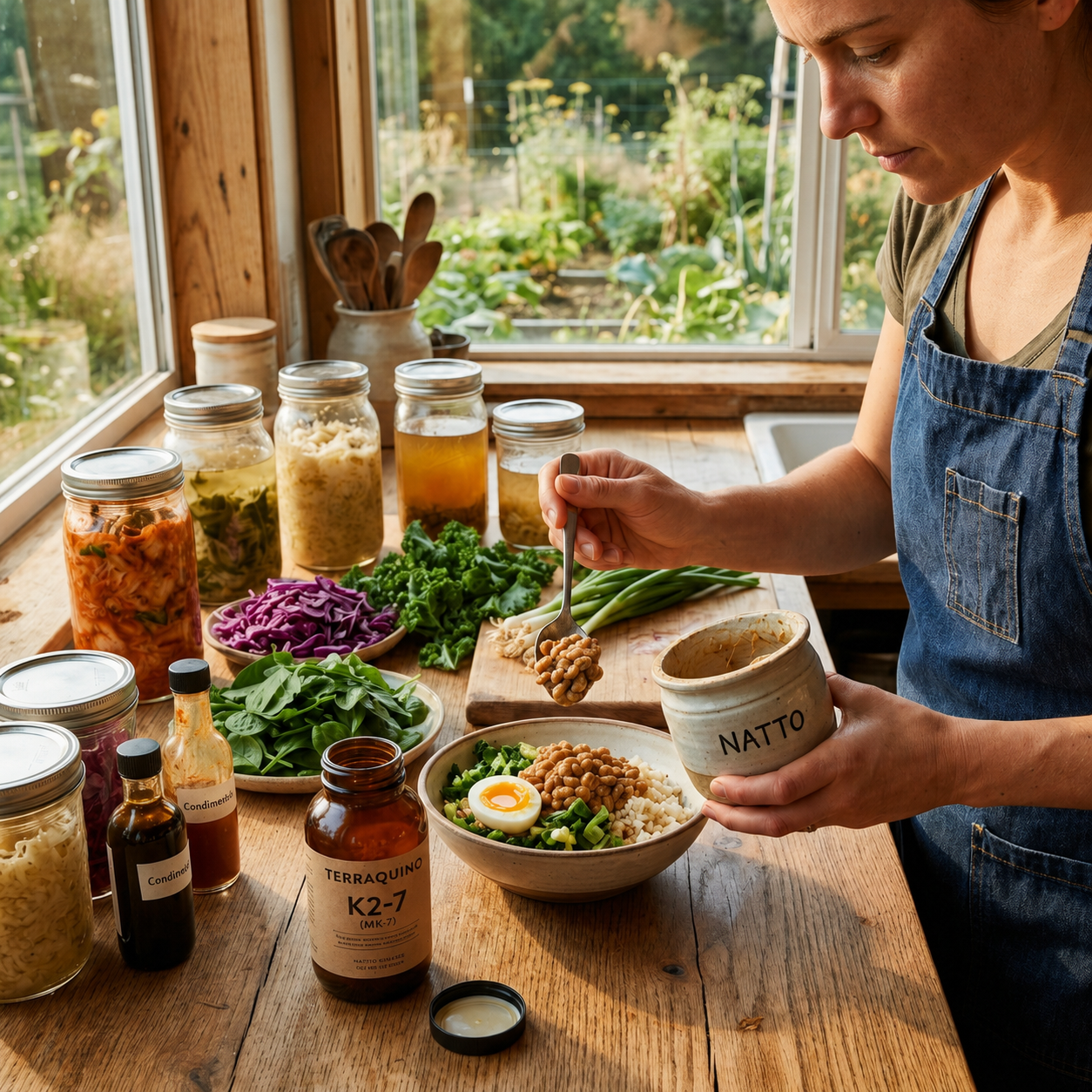
Natto is the only whole food that moves the provides a reliable solution. A 10 grams spoonful supplies roughly 90 micrograms of MK-7. Fermented soy pastes also help a little, sauerkraut and kimchi contributes mainly K1, and leafy greens do nothing for K2 at all.
That leaves supplemental MK-7 as a good option. There is one thing worth stating that anyone on warfarin should not change their vitamin K intake without talking to their doctor first.
Where TerraQuino Fits
TerraQuino is a nutraceutical ingredient brand built around vitamin K2-7, specifically MK-7, which is the form the bioavailability data really supports rather than MK-4 that struggles to reach the bloodstream at all.
K2-7 is allergen-free, produced by controlled bacterial fermentation with no extraction from animal tissue anywhere in the chain. It is designed to be formulated across tablets, capsules, softgels, sachets and liquids.
Frequently Asked Questions
Do vegans really need a vitamin K2 supplement?
Not automatically. There is no official K2 requirement and nobody has demonstrated widespread clinical deficiency in plant-based eaters. The fact that is clear is that unless natto or fermented soybean paste is on your plate regularly, your diet contains almost no K2 and gut bacteria may not be able to fill the gap. Given the low cost and good safety record, many vegans find supplementation an easier way.
Isn’t the vitamin K1 in leafy greens enough?
For blood clotting, it is. K1 disappears from the bloodstream quickly and is mostly used by the liver, while K2 circulates longer and reaches bone and arteries. In the Rotterdam cohort, K1 intake showed no association with heart outcomes while K2 intake did (Geleijnse et al., 2004).
MK-4 or MK-7, which one should I look for?
MK-7. Compared on different parameters, MK-4 failed to raise serum levels, while MK-7 accumulated in every participant. Its longer half-life is also why once-daily dosing works.
References
Fu, X., Harshman, S. G., Shen, X., Haytowitz, D. B., Karl, J. P., Wolfe, B. E., & Booth, S. L. (2017). Multiple vitamin K forms exist in dairy foods. Current Developments in Nutrition, 1(6), e000638. https://doi.org/10.3945/cdn.117.000638
García-Maldonado, E., Gallego-Narbón, A., Zapatera, B., Alcorta, A., Martínez-Suárez, M., & Vaquero, M. P. (2024). Bone remodelling, vitamin D status, and lifestyle factors in Spanish vegans, lacto-ovo vegetarians, and omnivores. Nutrients, 16(3), 448. https://doi.org/10.3390/nu16030448
Gast, G. C. M., de Roos, N. M., Sluijs, I., Bots, M. L., Beulens, J. W. J., Geleijnse, J. M., Witteman, J. C., Grobbee, D. E., Peeters, P. H. M., & van der Schouw, Y. T. (2009). A high menaquinone intake reduces the incidence of coronary heart disease. Nutrition, Metabolism and Cardiovascular Diseases, 19(7), 504–510. https://doi.org/10.1016/j.numecd.2008.10.004
Geleijnse, J. M., Vermeer, C., Grobbee, D. E., Schurgers, L. J., Knapen, M. H. J., van der Meer, I. M., Hofman, A., & Witteman, J. C. M. (2004). Dietary intake of menaquinone is associated with a reduced risk of coronary heart disease: The Rotterdam Study. The Journal of Nutrition, 134(11), 3100–3105. https://doi.org/10.1093/jn/134.11.3100
Karl, J. P., Meydani, M., Barnett, J. B., Vanegas, S. M., Barger, K., Fu, X., Goldin, B., Kane, A., Rasmussen, H., Vangay, P., Knights, D., Jonnalagadda, S. S., Saltzman, E., Roberts, S. B., Meydani, S. N., & Booth, S. L. (2017). Fecal concentrations of bacterially derived vitamin K forms are associated with gut microbiota composition but not plasma or fecal cytokine concentrations in healthy adults. The American Journal of Clinical Nutrition, 106(4), 1052–1061. https://doi.org/10.3945/ajcn.117.155424
Sato, T., Schurgers, L. J., & Uenishi, K. (2012). Comparison of menaquinone-4 and menaquinone-7 bioavailability in healthy women. Nutrition Journal, 11(1), 93. https://doi.org/10.1186/1475-2891-11-93
Shea, M. K., Berkner, K. L., Ferland, G., Fu, X., Holden, R. M., & Booth, S. L. (2021). Perspective: Evidence before enthusiasm—A critical review of the potential cardiovascular benefits of vitamin K. Advances in Nutrition, 12(3), 632–646. https://doi.org/10.1093/advances/nmab004
Tarvainen, M., Fabritius, M., & Yang, B. (2019). Determination of vitamin K composition of fermented food. Food Chemistry, 275, 515–522. https://doi.org/10.1016/j.foodchem.2018.09.136
Tong, T. Y. N., Appleby, P. N., Armstrong, M. E. G., Fensom, G. K., Knuppel, A., Papier, K., Perez-Cornago, A., Travis, R. C., & Key, T. J. (2020). Vegetarian and vegan diets and risks of total and site-specific fractures: Results from the prospective EPIC-Oxford study. BMC Medicine, 18(1). https://doi.org/10.1186/s12916-020-01815-3
Vossen, L. M., de Leeuw, P. W., Schurgers, L. J., Heuts, S., Adriaans, B. P., de Haan, C., van Varik, B. J., & Kroon, A. A. (2026). Two years of menaquinone-7 supplementation and coronary artery calcification: A randomized clinical trial. JAMA Cardiology, 11(8), 719. https://doi.org/10.1001/jamacardio.2026.1279