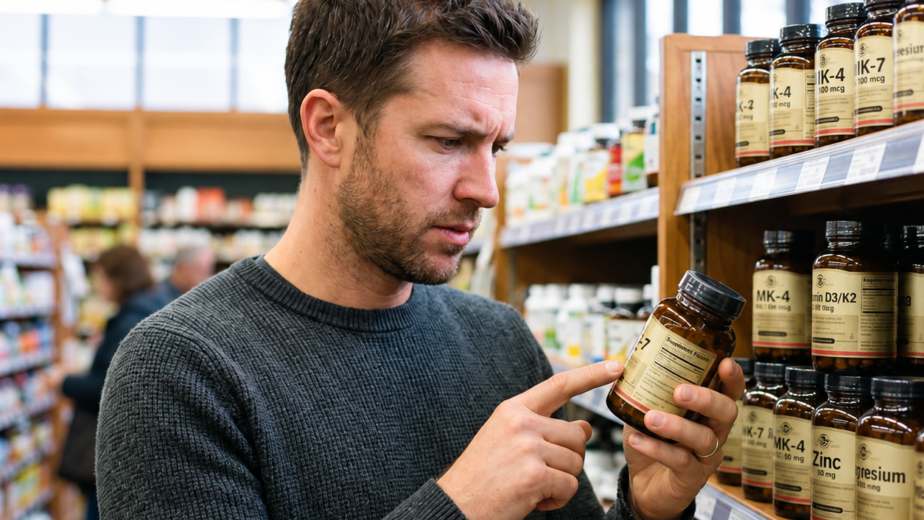
Vitamin K is a fat-soluble vitamin, and it comes in two families. Vitamin K1 (phylloquinone) is made by plants and comes mostly from leafy greens whereas Vitamin K2 (menaquinone) is made by bacteria and is present in fermented foods and animal products.
When you get a cut or injury, your body needs to stop the bleeding. Vitamin K helps activate several proteins involved in the blood-clotting process, allowing the blood to form a clot and prevent excessive bleeding. Without enough Vitamin K, the blood may take longer to clot.
Vitamin K also plays an important role in maintaining strong and healthy bones. It helps activate a protein called osteocalcin, which helps bind calcium to the bone. In this way, Vitamin K supports the proper use of calcium and contributes to maintaining bone strength.
It also helps regulate where calcium is deposited in the body, supporting healthy blood vessels and bones.
Signs of Deficiency
Classical vitamin K deficiency shows up as bleeding which includes easy bruising, nosebleeds, bleeding gums, slow clotting after a cut. In healthy it is rare.
The low-level kind has no signs at all. No symptoms, no warning, nothing you would notice. That is not a gap, instead it is the defining feature.
Reason People Fall Short of Vitamin K2
Unlike vitamin K1, which is found mainly in green leafy vegetables, Vitamin K2 is found in specific foods such as fermented foods and some animal products.
Some common reasons people may fall short of Vitamin K2 include:
• Low intake of K2-rich foods: People who rarely eat fermented foods, certain cheeses, eggs, or animalbased foods may consume less K2.
• Limited variety in the diet: A highly processed diet with very few whole or fermented foods may provide less Vitamin K2.
• Digestive or absorption problems: Since Vitamin K is fat-soluble, conditions that interfere with fat digestion or absorption can affect the body’s ability to absorb it properly.
• Certain medications: Some medications can interfere with Vitamin K metabolism or absorption.
• Reduced production by gut bacteria: Some Vitamin K2 forms can be produced by bacteria in the intestine, so changes in gut health may potentially influence Vitamin K availability.
• Individual differences: The body’s ability to absorb, produce, and use different forms of Vitamin K can vary from person to person.
What Happens to Vitamin K2 After Absorption?
After Vitamin K2 is absorbed from the intestine, it enters the bloodstream and is transported to different tissues. The liver receives a significant portion of Vitamin K first, where Vitamin K is used to activate proteins involved in blood clotting.
However, different forms of K2 behave differently in the body. MK-4 has a relatively short half-life, meaning it is cleared from the bloodstream more quickly and does not remain in circulation for very long. In contrast, MK-7 stays in the bloodstream much longer because it is cleared more slowly. This longer circulation time allows MK-7 to remain available to tissues for a more extended period.
Therefore, although both are forms of Vitamin K2, MK-4 is more short-acting, while MK-7 has a longer-lasting presence in the blood.
Why is K2 Deficiency Difficult to Identify?
It is because the body does not have a simple, routine test that specifically measures K2 levels. Also, Vitamin K exists in different forms, such as K1 and K2, and standard blood tests generally assess overall Vitamin K status or its effect on blood clotting, rather than measuring K2 specifically.
Another reason is that the body can store and recycle Vitamin K, and some forms of K2 can also be produced by gut bacteria. Because of this, a person may not immediately show obvious symptoms when their intake is low. Early or mild insufficiency may remain unnoticed until it affects processes such as normal blood clotting or bone metabolism.
What Happens When Level Stays Low?
More osteocalcin circulates without being activated, so less of the protein that anchors calcium into bone is doing its job. Matrix Gla Protein (MGP) in the artery wall is less able to block mineral deposits.
Whether that translates into fractures and heart attack is still being worked out. In PREVEND, higher dp-ucMGP was associated with higher all-cause and cardiovascular mortality, but an association in an observational study is not proof of cause (Riphagen et al., 2017). On the trial side, a 2025 meta-analysis of 9 trials covering 2.570 postmenopausal women with osteoporosis found K2 supplementation raised osteocalcin and reduced its undercarboxylated fraction, with the authors noting longer studies are needed to confirm outcomes such as increased bone mineral density (Zhang et al., 2025).
Sources of Vitamin K2
Natto, a fermented soybean food, is the richest source by a wide margin which is roughly 850 µg of MK-7 per 3ounce serving. Cheese, other fermented foods and animal products contribute far less, with cheddar sitting near 4 µg per 1.5 ounces as MK-4, and cheese content varying with the bacterial strains used (National Institutes of Health, n.d.).
Gut bacteria do produce menaquinones. Most of it stays bound to bacterial membranes and absorption is poor.
How to Maintain Adequate Vitamin K Status?
Food is the first move. Fermented foods, cheese, eggs and leafy greens all contribute, and because vitamin K is fatsoluble, a meal containing some fat improves absorption.
If you use a supplement, stay within the range that has been studied rather than reaching for the biggest number on the shelf. Check that the label names the form, whether it is MK-4 or MK-7, rather than just saying “vitamin K2.” And if you take warfarin, the rule is consistency, not avoidance. Vitamin K works directly against the drug, so sudden changes in intake shift its effect in either direction (National Institutes of Health, n.d.). Consult a doctor before starting or stopping a supplement.
The Real Problem is “Awareness”
Vitamin K2 insufficiency is not rare or exotic. It is invisible, which is a different thing.
It produces no symptoms, no abnormal results on any test performed, and no flag against an intake recommendation built around blood clotting in the first place. A person can sit above every official threshold while the proteins in their bones and arteries are only partly switched on.
Knowing the gap exists is most of the work. The rest is ordinary. Eat the food rich in vitamin K, pay attention if you are in a higher-risk group, and consult a doctor rather than guessing.
Where TerraQuino Fits
TerraQuino supplies vitamin K2-7 (MK-7) as an ingredient, produced by a controlled fermentation process, supplied allergen-free, and used in tablets, capsules, soft gels, sachets and liquids.
For brands developing supplements, TerraQuino offers flexibility in creating combined-nutrient products. Vitamin K2-7 can be paired with ingredients such as Vitamin D3, calcium salts, omega-3s, probiotics, Vitamins C and E, and zinc, making it easier for product developers to create well-rounded formulations. Its standardized processes are also designed to support consistent quality and stability from batch to batch.
Frequently Asked Questions
Does a normal blood test rule out low vitamin K2?
No. Blood calcium is hormonally controlled, and clotting is supplied first, so both can look completely normal while bone and vascular proteins are undercarboxylated.
Can I get tested for vitamin K2 deficiency?
Not through a standard panel. Research uses undercarboxylated osteocalcin and dp-ucMGP, and neither is a routine clinical test
Will eating more leafy greens fix it?
Greens supply K1, which the liver clears quickly. K2 comes from fermented foods and animal products, and it behaves differently once absorbed.
References
Berkner, K. L., & Runge, K. W. (2022). Vitamin K-dependent protein activation: Normal gamma-glutamyl carboxylation and disruption in disease. International Journal of Molecular Sciences, 23(10), Article 5759. https://doi.org/10.3390/ijms23105759
Lai, Y., Masatoshi, H., Ma, Y., Guo, Y., & Zhang, B. (2021). Role of vitamin K in intestinal health. Frontiers in Immunology, 12, Article 791565. https://doi.org/10.3389/fimmu.2021.791565
National Institutes of Health, Office of Dietary Supplements. (n.d.). Vitamin K: Fact sheet for health professionals. Retrieved October 2, 2026, from https://ods.od.nih.gov/factsheets/VitaminK-HealthProfessional/
Ren, R., Liu, J., Cheng, G., & Tan, J. (2021). Vitamin K2 (menaquinone-7) supplementation does not affect vitamin K-dependent coagulation factors activity in healthy individuals. Medicine, 100(23), Article e26221. https://doi.org/10.1097/MD.0000000000026221
Riphagen, I. J., Keyzer, C. A., Drummen, N. E. A., De Borst, M. H., Beulens, J. W. J., Gansevoort, R. T., Geleijnse, J. M., Muskiet, F. A. J., Navis, G., Visser, S. T., Vermeer, C., Kema, I. P., & Bakker, S. J. L. (2017). Prevalence and effects of functional vitamin K insufficiency: The PREVEND study. Nutrients, 9(12), Article 1334. https://doi.org/10.3390/nu9121334
Schurgers, L., Teunissen, K., Hamulyák, K., Knapen, M., Vik, H., & Vermeer, C. (2007). Vitamin K-containing dietary supplements: Comparison of synthetic vitamin K1 and natto-derived menaquinone-7. Blood, 109(8), 3279–3283. https://doi.org/10.1182/blood-2006-08-040709
Theuwissen, E., Cranenburg, E. C., Knapen, M. H., Magdeleyns, E. J., Teunissen, K. J., Schurgers, L. J., Smit, E., & Vermeer, C. (2012). Low-dose menaquinone-7 supplementation improved extrahepatic vitamin K status, but had no effect on thrombin generation in healthy subjects. British Journal of Nutrition, 108(9), 16521657. https://www.cambridge.org/core/journals/british-journal-of-nutrition/article/lowdose-menaquinone7supplementation-improved-extrahepatic-vitamin-k-status-but-had-no-effect-on-thrombin-generation-inhealthy-subjects/D25A8ED353E8F199EEAE9905D716A88E
Zhang, Z., Li, Y., Li, J., Yuan, Y., Liu, K., & Shi, X. (2025). The effect of vitamin K2 supplementation on bone turnover biochemical markers in postmenopausal osteoporosis patients: A systematic review and metaanalysis. Frontiers in Endocrinology, 16, Article 1703116. https://doi.org/10.3389/fendo.2025.1703116