If you’re over 40 and still training hard, you’ve probably noticed it. The soreness that used to fade in a day now lingers for three. A tweak that would have healed in a week now takes a month. Most people write this off as “just getting older” and leave it there. But when researchers who study bone and muscle look closely at what’s actually changing during recovery, one thread keeps showing up: a nutrient almost no training plan ever mentions, quietly doing a job most athletes have never heard of.
What’s Really Slowing Your Recovery
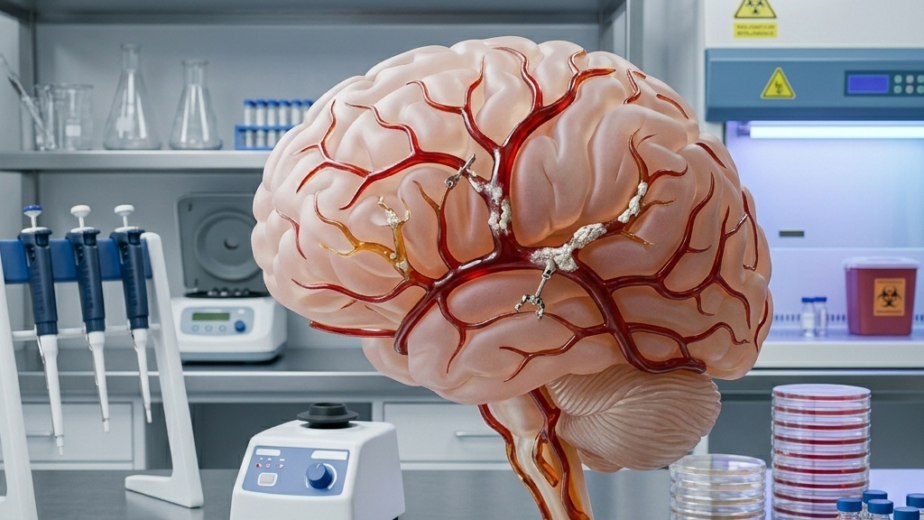
Bone and connective tissue aren’t fixed structures. They’re being rebuilt constantly then broken down in small amounts and reformed, over and over, your whole life. That rebuilding depends on a protein called osteocalcin, made by bone cells, which has to be “switched on” before it can do its job of directing calcium into the right places.
Vitamin K is the switch.
A recent research review pulled together the current evidence on this system and found that it doesn’t just matter for bone, it is also tied to muscle strength, muscle mass, and physical performance too, particularly as people age (Ran et al., 2026). The review was also honest about the limits that this connection is well supported by observational research, but controlled trials testing it directly are still catching up.
The Muscle Conversation
Osteocalcin doesn’t just work on bone. Once activated, it also signals to muscle tissue, helping muscle cells take up glucose and use energy more efficiently which is exactly what you need during a hard training session or a long recovery window (Ran et al., 2026).
Scientists sometimes call this the bone-muscle conversation, and it’s a genuinely newer area of exercise science, not something that shows up in a typical sports nutrition guide. It’s also a reasonable explanation for why recovery capacity doesn’t just depend on protein and sleep, it depends on this activation system working properly, and that system slows with age.
What the Research Shows
It’s worth being straightforward about where the evidence stands, because not every study lines up neatly. A 14.5-year study of over 1,300 older Australian women found that higher intake of vitamin K1 — the plant-based form, common in leafy greens was linked to better physical function and a lower long-term risk of injury-related falls. Vitamin K2 intake, measured in the same women, wasn’t associated with either outcome in this particular study (Sim et al., 2023).
Separately, a three-year randomized trial in older adults found that vitamin K supplementation successfully activated more osteocalcin as expected, but that didn’t translate into a measurable change in muscle mass or fat mass over that period (Shea et al., 2017). Put together, the mechanism is real and well documented; the proof that supplementing with K2 specifically changes muscle outcomes in people is still being built.
Why the Form Still Matters If You’re Considering It
Recovery isn’t a one-time event instead it’s something your body is doing every single day you train. That makes the type of vitamin K2 relevant, not just whether you’re getting some. A bioavailability study found that after a single dose, the MK-7 form of K2 stayed detectable in the blood for up to 48 hours, while the MK-4 form, given at the same dose, wasn’t detectable at any point measured (Sato et al., 2012). For a system that needs to be switched on consistently, day after day, a form that disappears within hours is a weaker fit than one that sticks around.
Where TerraQuino Comes In
TerraQuino produces MK-7 through a controlled fermentation process, delivering the long-chain, allergen-free vitamin K2-7 associated with the longer-lasting blood levels described above.
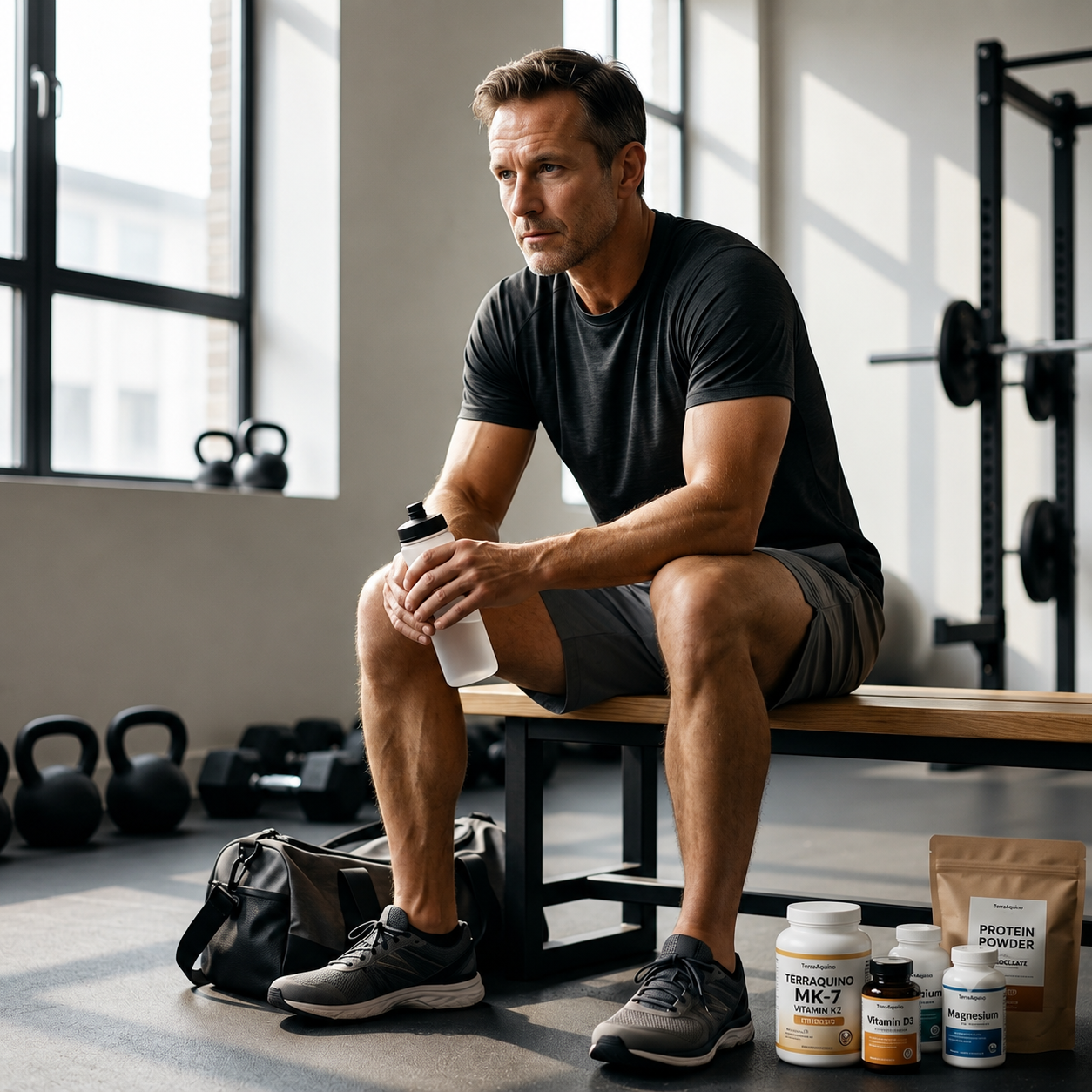
It’s formulated for tablets, capsules, softgels, sachets, and liquids, and pairs cleanly with vitamin D3, calcium, magnesium, and protein-focused ingredients common in recovery formulas.
TerraQuino doesn’t claim its ingredient improves athletic recovery on its own, that specific research is still developing but it gives formulators a bioavailability-tested K2 source built for exactly this kind of daily-use formula.
FAQs
Does vitamin K2 actually speed up recovery for older athletes?
Not proven directly yet. The mechanism connecting vitamin K to bone and muscle activation is well documented (Ran et al., 2026), but no trial has tested K2 specifically against recovery time in athletes.
Should I focus on vitamin K1 or K2 for muscle and bone health?
The one long-term study that tracked both found a benefit tied to K1 intake for physical function and falls risk, with no equivalent finding for K2 in that same group of women (Sim et al., 2023). More research on K2 specifically, especially in athletic populations, would help settle this.
Why does recovery really slow down after 40 in the first place?
Several systems change with age at once like hormone levels, inflammation resolution, and the bone-remodeling and muscle-signaling pathway involving osteocalcin all shift gradually (Ran et al., 2026). It’s rarely just one cause.
Is it safe to combine vitamin K2 with other recovery supplements?
Vitamin K2 is generally well tolerated, but it does interact directly with blood-thinning medications like warfarin. Anyone on those medications, or with an existing health condition, should check with a doctor before adding any form of vitamin K to a supplement routine.
References
Ran, X., Jiang, Y., Mao, L., Chen, X., Jing, D., Tang, X., & Tan, J. (2026). Vitamin K and muscle health: Mechanisms and clinical perspectives in sarcopenia and beyond: Narrative review. Frontiers in Nutrition, 13, Article 1726483. https://doi.org/10.3389/fnut.2026.1726483
Sato, T., Schurgers, L. J., & Uenishi, K. (2012). Comparison of menaquinone-4 and menaquinone-7 bioavailability in healthy women. Nutrition Journal, 11, Article 93. https://doi.org/10.1186/1475-2891-11-93
Shea, M. K., Barger, K., Dawson-Hughes, B., Leaf, A., Booth, S. L., & Kiel, D. P. (2017). Reducing undercarboxylated osteocalcin with vitamin K supplementation does not promote lean tissue loss or fat gain over 3 years in older women and men: A randomized controlled trial. Journal of Bone and Mineral Research, 32(2), 243–249. https://doi.org/10.1002/jbmr.2989
Sim, M., Smith, C., Bondonno, N. P., Radavelli-Bagatini, S., Blekkenhorst, L. C., Dalla Via, J., McCormick, R., Zhu, K., Hodgson, J. M., Prince, R. L., & Lewis, J. R. (2023). Higher dietary vitamin K intake is associated with better physical function and lower long-term injurious falls risk in community-dwelling older women. The Journal of Nutrition, Health & Aging, 27(1), 38–45. https://doi.org/10.1007/s12603-022-1866-9