MK-4 and MK-7 are the two forms of the vitamin K2. They belong to the same family, yet they behave very differently in the body. One stays in your blood for days while the other just for a few hours.
But first, let’s understand Vitamin K.
Vitamin K is a group of fat-soluble vitamins. The two main types are vitamin K1 (phylloquinone), found mostly in leafy greens, and vitamin K2, a family of compounds called menaquinones. Our body uses vitamin K to switch on certain proteins: Osteocalcin and Matrix Gla Protein.
Osteocalcin helps lock calcium into bone, and Matrix Gla Protein helps stop calcium from getting accumulated in blood vessel walls. The number after “MK” counts the repeating units in the molecule’s side chain or tail. So, MK-4 has four and MK-7 has seven repeating units. This difference in their length changes how long each form lasts in the body.
MK-4 and MK-7
MK-4 is also called as menatetrenone. It is the short-chain form. MK-4 is found in animal-based foods. Your body can produce it too. Tissues in the body convert vitamin K1 into MK-4 using an enzyme called UBIAD1.
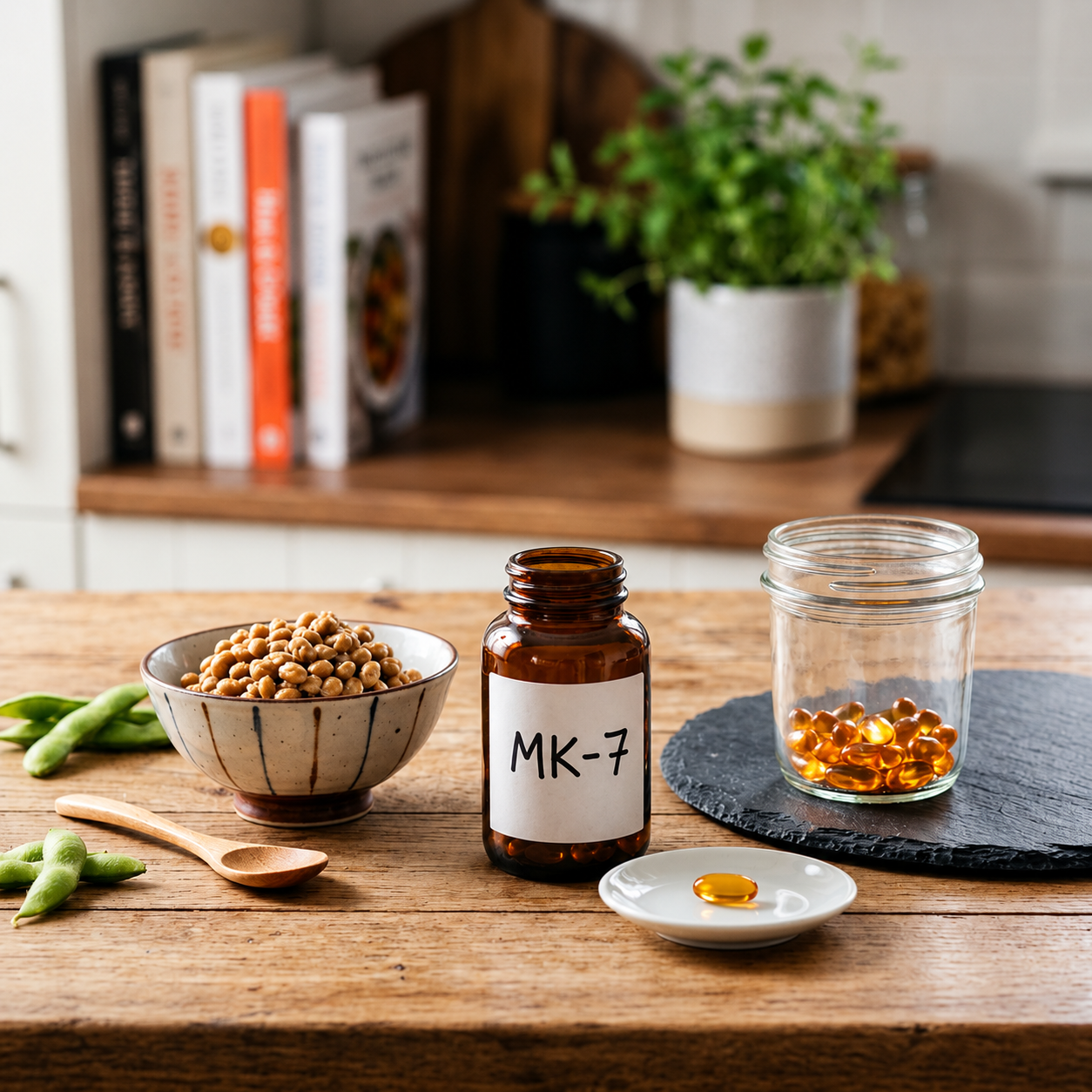
MK-7 is the long-chain form. It is made by bacteria, and its richest food source is natto, a Japanese dish of fermented soybeans. Supplement makers produce it through controlled fermentation. MK-7 has real sustaining capabilities. It lasts longer in blood in comparison to MK-4.
The Comparison Table
| Aspect | MK-4 | MK-7 |
| Side chain | 4 repeating units (short) | 7 repeating units (long) |
| Where it comes from | Animal-based foods; body tissues also make it from vitamin K1 | Made by bacteria; richest food source is natto (fermented soybeans) |
| Made inside the human body? | Yes, through the enzyme UBIAD1 | No; human cells do not make it |
| Blood levels after one 420 µg dose | Not detectable at any time point | Peaked at 6 hours; still detectable at 48 hours |
| Effect of daily intake | 60 µg/day for 7 days did not raise blood levels | 60 µg/day for 7 days raised blood levels in every participant |
| Doses used in major trials | 15–45 mg/day (mostly Japanese fracture trials) | 180 µg/day (3-year bone trial); 720 µg/day (AVADEC heart valve trial) |
| Main human evidence | Fewer fractures in trials, mostly in Japanese patients | Slower bone loss in postmenopausal women; no effect on aortic valve calcium |
| Interaction with warfarin | Any vitamin K can weaken warfarin; keep intake steady | 50 µg/day or more may interfere; 10 µg affected some people |
| Safety benchmark | No upper limit set for vitamin K | Highest observed intake: 375 µg/day for adults (not for warfarin users) |
Sources: Cockayne et al. (2006); CRN (2025); Diederichsen et al. (2022); Knapen et al. (2013); Nakagawa et al. (2010); NIH (2021); Sato et al. (2012); Schurgers et al. (2007); Theuwissen et al. (2013).
Safety and Drug Interaction
For most heathy adults, vitamin K has a clean record. U.S. experts set no upper intake limit because no harm from vitamin K in food or supplements had been reported. In 2025, the Council for Responsible Nutrition reviewed over 40 clinical trials and set a highest observed intake of 375 µg of MK-7 a day for adults (Council for Responsible Nutrition [CRN], 2025).
The major exception is warfarin and similar blood thinners. These drugs work by blocking vitamin K, so extra K2 can weaken them.
- Doses of 50 µg of MK-7 a day or more may interfere with anticoagulant treatment (Schurgers et al., 2007).
- Even 10 µg a day significantly changed clotting results in some volunteers (Theuwissen et al., 2013).
- Warfarin users should keep vitamin K intake steady, since sudden changes can raise or lower the drug’s effect (NIH, 2021).
Long antibiotic courses can lower the vitamin K made by gut bacteria, while bile acid sequestrants (cholesterol medicines) and orlistat (a weight-loss medicine) can reduce absorption (NIH, 2021).
How TerraQuino Fits
TerraQuino supplies vitamin K2-7 (MK-7) as an ingredient, produced by a controlled fermentation process, supplied allergen-free, and used in tablets, capsules, softgels, sachets and liquids.
For brands developing supplements, TerraQuino offers flexibility in creating combined-nutrient products. Vitamin K2-7 can be paired with ingredients such as Vitamin D3, calcium salts, omega-3s, probiotics, Vitamins C and E, and zinc, making it easier for product developers to create well-rounded formulations. Its standardized processes are also designed to support consistent quality and stability from batch to batch.
Frequently Asked Questions
Is MK-4 or MK-7 better absorbed by the body?
Both forms can be ingested by an individual, but MK-7 has a longer half-life than MK-4 and produces higher concentrations of the substance in the blood. Scientific research has proven that ingestion of MK-7 on a daily basis increases levels of vitamin K in the blood, while MK-4 does not.
Can vitamin K2 interact with blood-thinning medicines?
Yes. Vitamin K can interfere with the action of anticoagulants such as warfarin because these medicines work by interfering with vitamin K metabolism. People taking warfarin or similar medicines should discuss vitamin K2 supplementation with their healthcare professional and keep their vitamin K intake consistent.
What foods contain MK-4 and MK-7?
MK-4 is found mainly in animal-derived foods and can also be produced by human tissues from vitamin K1. MK-7 is produced by certain bacteria and is particularly abundant in natto, a traditional Japanese fermented soybean food.
References
Cockayne, S., Adamson, J., Lanham-New, S., Shearer, M. J., Gilbody, S., & Torgerson, D. J. (2006). Vitamin K and the prevention of fractures: Systematic review and meta-analysis of randomized controlled trials. Archives of Internal Medicine, 166(12), 1256–1261. https://doi.org/10.1001/archinte.166.12.1256
Council for Responsible Nutrition. (2025, November 20). Vitamin K2 users get good news: CRN’s new analysis confirms strong safety record for MK-7 supplements [Press release]. https://www.crnusa.org/newsroom/vitamin-k2-users-get-good-news-crns-new-analysis-confirms-strong-safety-record-mk-7
Diederichsen, A. C. P., Lindholt, J. S., Möller, S., Øvrehus, K. A., Auscher, S., Lambrechtsen, J., Hosbond, S. E., Alan, D. H., Urbonaviciene, G., Becker, S. W., Fredgart, M. H., Hasific, S., Folkestad, L., Gerke, O., Rasmussen, L. M., Møller, J. E., Mickley, H., & Dahl, J. S. (2022). Vitamin K2 and D in patients with aortic valve calcification: A randomized double-blinded clinical trial. Circulation, 145(18), 1387–1397. https://doi.org/10.1161/CIRCULATIONAHA.121.057008
Knapen, M. H. J., Drummen, N. E., Smit, E., Vermeer, C., & Theuwissen, E. (2013). Three-year low-dose menaquinone-7 supplementation helps decrease bone loss in healthy postmenopausal women. Osteoporosis International, 24(9), 2499–2507. https://doi.org/10.1007/s00198-013-2325-6
Nakagawa, K., Hirota, Y., Sawada, N., Yuge, N., Watanabe, M., Uchino, Y., Okuda, N., Shimomura, Y., Suhara, Y., & Okano, T. (2010). Identification of UBIAD1 as a novel human menaquinone-4 biosynthetic enzyme. Nature, 468(7320), 117–121. https://doi.org/10.1038/nature09464
National Institutes of Health, Office of Dietary Supplements. (2021, March 29). Vitamin K: Fact sheet for health professionals. https://ods.od.nih.gov/factsheets/VitaminK-HealthProfessional/
Sato, T., Schurgers, L. J., & Uenishi, K. (2012). Comparison of menaquinone-4 and menaquinone-7 bioavailability in healthy women. Nutrition Journal, 11, Article 93. https://doi.org/10.1186/1475-2891-11-93
Schurgers, L. J., Teunissen, K. J. F., Hamulyák, K., Knapen, M. H. J., Vik, H., & Vermeer, C. (2007). Vitamin K–containing dietary supplements: Comparison of synthetic vitamin K1 and natto-derived menaquinone-7. Blood, 109(8), 3279–3283. https://doi.org/10.1182/blood-2006-08-040709
Theuwissen, E., Teunissen, K. J., Spronk, H. M. H., Hamulyák, K., Ten Cate, H., Shearer, M. J., Vermeer, C., & Schurgers, L. J. (2013). Effect of low-dose supplements of menaquinone-7 (vitamin K2) on the stability of oral anticoagulant treatment: Dose–response relationship in healthy volunteers. Journal of Thrombosis and Haemostasis, 11(6), 1085–1092. https://doi.org/10.1111/jth.12203