How absurd does this sound to you?
“Your skeleton helps run your metabolism.”
It does. In its own way.
For a long time, bones have been viewed as an inert component simply for bodily support. However, bones are dynamic organs that interact with other parts of the body through hormones that affect metabolic functions, the pancreas, and adipose tissue. The hormone involved is called osteocalcin, while the nutritional factor that determines its function is Vitamin K2.
In a research from Columbia University, scientists led by Gerard Karsenty showed that osteocalcin, made by bone-building cells, behaves like a metabolic messenger. In animal models, it nudges the pancreas to release more insulin, encourages insulin-producing beta cells to multiply, and prompts fat tissue to secrete adiponectin which is a hormone that helps the body use insulin more efficiently.
But osteocalcin exists in different forms depending on a chemical step called carboxylation and that step is entirely dependent on Vitamin K. Without enough K, osteocalcin’s activity isn’t properly regulated and the finely tuned signalling that helps govern glucose metabolism and fat-tissue behaviour can drift off balance.
Where Vitamin K2 Steps In
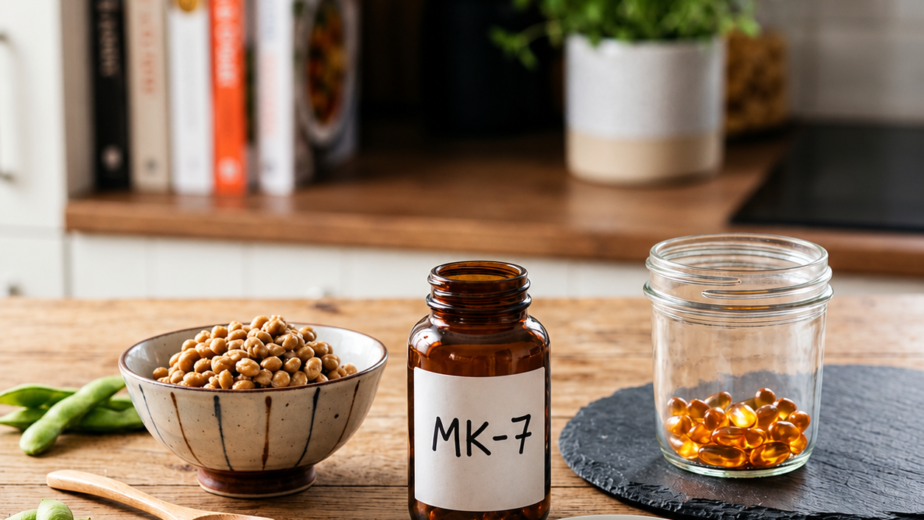
K2 vitamin, especially the longer chain form known as menaquinone-7 (MK-7), is key in the carboxylation of osteocalcin. One of the clinical indications that K2 might have an impact on metabolic health came from the results of a placebo-controlled study, carried out by Choi et al. in 2011 and published in Diabetes Care. It involved forty-two healthy young males, and the effect on their insulin sensitivity was seen within only four weeks, following the administration of K2 supplements.
The association is not just limited to healthy individuals. As in a randomised, double-blind trial of people with type 2 diabetes, three months of Vitamin D3 plus K2 supplementation reduced undercarboxylated osteocalcin and improved insulin resistance (measured by HOMA-IR).
This field is genuinely exciting but still young. The studies are conducted on relatively low numbers of patients, many of whom took MK-4 supplements instead of MK-7 in large dosages. Scientists still cannot agree which type of osteocalcin acts as an active ingredient in metabolism for humans. This sounds great biologically and the results obtained in humans show some promise, yet K2 is just the beginning.
How TerraQuino Helps
TerraQuino supplies a premium, allergen-free Vitamin K2-7 (MK-7) produced through a controlled fermentation process and engineered for high bioavailability and stability. With formulation flexibility across capsules, softgels, sachets, and liquids, TerraQuino gives the brands you trust a research-driven K2-7 to build dependable products around.
Metabolism was always told as a tale of diet and exercise, the realization that bones are an endocrine tissue regulated by K2, and thus the hormone responsible for it, represents yet another silent element in the equation. Maintaining your own adequate K2 levels means optimizing the very mechanisms which allow you to process sugar.
Frequently Asked Questions
- How does Vitamin K2 affect blood sugar and insulin?
The action of vitamin K2 is associated with osteocalcin, a hormone secreted by bones that plays a role in glucose metabolism. Osteocalcin regulates the secretion of insulin. Without enough K2, that signalling isn’t properly regulated.
- Is there human research, or just animal studies?
Both. Hormone pathways were first discovered through experiments on animals, but a study in Diabetes Care from 2011 showed that vitamin K2 supplementation over four weeks enhanced insulin sensitivity in healthy males, whereas a different trial among type 2 diabetic patients showed improvements in insulin resistance using vitamins D3 and K2.
- Can Vitamin K2 prevent or treat diabetes?
No. Results look encouraging but more research is needed since the studies conducted are still relatively small. However, K2 can certainly be considered as an auxiliary factor in the maintenance of optimal metabolic health along with proper nutrition and exercise.