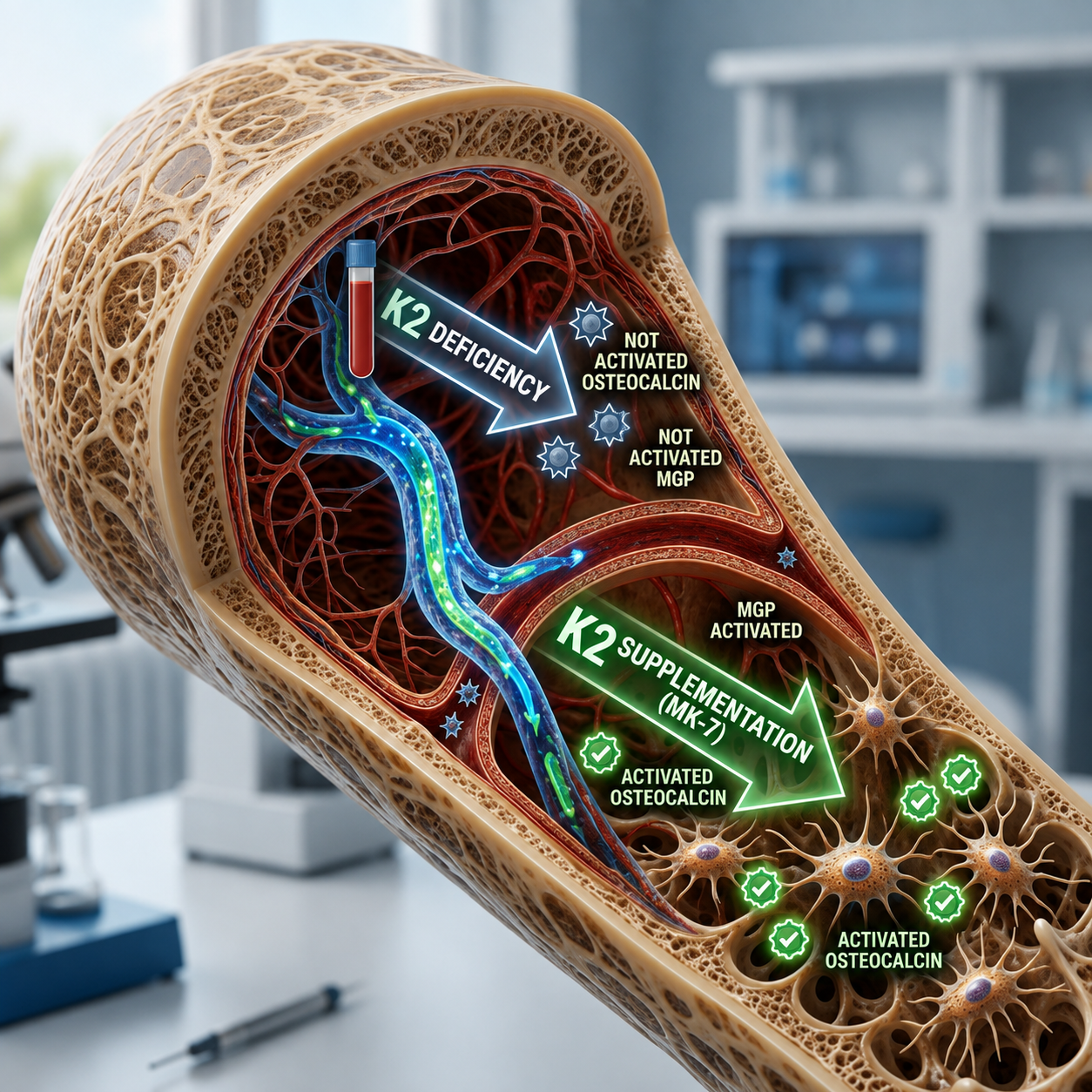
Vitamin K is usually checked using Prothrombin Time (PT) or INR tests. However, these tests are not actually designed to measure how much vitamin K a person has. PT and INR tests measure how quickly blood clots, doctors mainly use them to find out if someone has a risk of abnormal bleeding, such as in liver disease or when taking blood-thinning medicines like warfarin. These tests are useful for checking whether the body has enough vitamin K to make clotting factors, but they do not tell us whether vitamin K levels are ideal for other functions, like maintaining strong bones or healthy blood vessels.
The problem is that the amount of vitamin K needed for normal blood clotting is much lower than the amount that may be needed for bone and cardiovascular health. So, a person can have a normal PT/INR result and still potentially have a vitamin K status that is not optimal for functions like activating bone proteins that help maintain bone strength and regulating calcium movement in blood vessels.
Why does the liver get priority for vitamin K?
Vitamin K is needed for making certain proteins in the body. The liver uses vitamin K first to produce blood-clotting proteins (called clotting factors) because preventing bleeding is an immediate survival need.
When vitamin K intake is low, the liver takes priority. The body uses available vitamin K to make clotting factors and this ensures that blood can clot properly and prevents excessive bleeding. Other tissues get the remaining vitamin K. Proteins in bones (like osteocalcin) and blood vessels (like matrix Gla protein) also need vitamin K to become active. However, these functions are considered less urgent compared with preventing life-threatening bleeding.
A study of 219 healthy adults found that typical dietary vitamin K intake, the kind that keeps clotting tests perfectly normal, was not enough to achieve maximal activation of osteocalcin, the bone protein (Binkley et al., 2000). Their normal diet provided enough vitamin K to keep their blood clotting tests normal. However, their osteocalcin (a bone protein) was not fully activated. This suggests that the amount of vitamin K needed to maintain normal clotting may be lower than the amount needed for optimal bone health.
What Happens When You Actually Test the Right Markers
The usual tests like PT and INR only tell us whether blood clotting is working properly. They do not give a complete picture of vitamin K activity in the body. Researchers use more sensitive markers, such as:
- Undercarboxylated osteocalcin (ucOC): shows whether vitamin K is sufficient for bone protein activation.
- Undercarboxylated matrix Gla protein (ucMGP): shows whether vitamin K is sufficient for protecting blood vessels by helping control calcium deposition.
If these proteins are not properly activated, it may indicate that the body does not have enough vitamin K for those specific functions.
Why do different tests give different results?
A study tested three different vitamin K status markers in the same group of 44 patients. The researchers found very different rates of vitamin K deficiency depending on the test used; one test suggested 13.6% of people had deficiency, another suggested 51% had deficiency and the third suggested 90.9% had deficiency.
This means the same group of people could be classified as having very different vitamin K status depending on which marker was measured.
It happens because different tests measure different aspects of vitamin K function in the body. The PT/INR test evaluates whether the blood clotting process is functioning normally, whereas ucOC (undercarboxylated osteocalcin) measures whether sufficient vitamin K is available to activate bone-related proteins, and ucMGP (undercarboxylated matrix Gla protein) indicates the availability of vitamin K for supporting blood vessel health. Therefore, a person may have a normal PT/INR value, showing adequate blood coagulation, but may still have insufficient vitamin K activity for the complete activation of proteins involved in maintaining bone strength and vascular health.
Why This Matters Beyond the Research Setting
This does not mean that routine blood tests are inadequate or that laboratories are overlooking important information. Rather, it highlights that specific biomarkers used to assess vitamin K2 activity in bones and blood vessels, such as ucOC and dp-ucMGP, are still mainly used in research studies and are not commonly included in standard health checkup panels. A person may show normal cholesterol levels, healthy clotting parameters, and adequate vitamin D status, yet these results may not reveal whether vitamin K2-dependent proteins in bone and vascular tissues are being fully activated. In other words, routine reports may appear complete, but they may not provide a complete picture of vitamin K2 status throughout the body.
Where TerraQuino Comes In
TerraQuino produces MK-7 through a controlled fermentation process, delivering long-chain, allergen-free vitamin K2-7 built for steady daily use.
It’s formulated for tablets, capsules, softgels, sachets, and liquids, giving formulators an ingredient suited to supporting the kind of ongoing vitamin K2 status that a once-a-year blood panel was never designed to catch.
Frequently Asked Questions
If my blood test came back normal, could I still be low in vitamin K2?
Yes, this is possible if your test only checked clotting-related markers like PT or INR, since these tests are described as insensitive for detecting broader vitamin K status (Paulus et al., 2024). A normal clotting result doesn’t rule out lower activation of bone or vascular proteins.
What test would actually show my real vitamin K2 status?
Undercarboxylated osteocalcin (ucOC) and dephospho-uncarboxylated MGP (dp-ucMGP) are the markers researchers use to assess bone and vascular vitamin K status specifically. They’re not part of standard commercial panels and typically require a specialty or research lab.
Why doesn’t my doctor order these tests routinely?
These markers aren’t standardized for everyday clinical use the way cholesterol or blood sugar tests are, and there’s no widely agreed diagnostic threshold for “deficient” yet (Paulus et al., 2024). That’s a gap in clinical infrastructure, not a sign the underlying biology isn’t real.
Does this mean everyone should get tested for vitamin K2?
Not necessarily. For most healthy adults, the more practical takeaway is ensuring consistent intake rather than chasing a specialty test. Anyone with a specific bone, cardiovascular, or clotting concern should raise vitamin K status directly with their doctor.
References
Binkley, N. C., Krueger, D. C., Engelke, J. A., Foley, A. L., & Suttie, J. W. (2000). Vitamin K supplementation reduces serum concentrations of under-γ-carboxylated osteocalcin in healthy young and elderly adults. The American Journal of Clinical Nutrition, 72(6), 1523–1528. https://doi.org/10.1093/ajcn/72.6.1523
Elliott, M. J., Booth, S. L., Hopman, W. M., & Holden, R. M. (2014). Assessment of potential biomarkers of subclinical vitamin K deficiency in patients with end-stage kidney disease. Canadian Journal of Kidney Health and Disease, 1, Article 13. https://doi.org/10.1186/2054-3581-1-13
Paulus, M. C., Drent, M., Kouw, I. W. K., Balvers, M. G. J., Bast, A., & van Zanten, A. R. H. (2024). Vitamin K: A potential missing link in critical illness—a scoping review. Critical Care, 28, Article 212. https://doi.org/10.1186/s13054-024-05001-2