Yes, you’re getting your greens. Yes, you’re getting enough calcium. Yes, you’re exercising regularly and have a good weight. However, somehow your knees creak a little more than they used to, your shoulders are tighter, and you experience more morning stiffness as each year progresses. Familiar scenario?
Regardless of whether you have done everything right, stiff and painful joints can be an inevitability of the aging process although not for the reasons you might think.
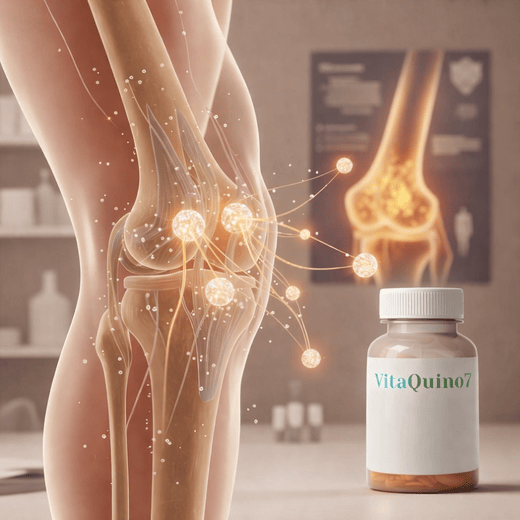
When we think about joint problems, most of us visualize cartilage damage and/or inflammation. However, the slow accumulation of soft tissue calcification is not only occurring under the surface but can also be a contributor to joint problems.
Soft-Tissue Calcification:
Calcium crystals can develop in areas where they are not naturally present, including cartilage, tendon, ligament and other types of soft tissue structures located around the joint. There have been several studies done looking at the knees from early to late years of age that show the leading contributor to calcium forming in cartilage was due to age and not osteoarthritis with every knee reviewed showing a form of calcium being found in the cartilage, including the younger knees (PMC, 2007).
The numbers are mind-boggling. Research shows that approximately 45% of individuals aged 85 years and older will have some degree of chondrocalcinosis (calcium deposits in the cartilage) and most will not know they have it. Because many cases of chondrocalcinosis develop asymptomatically, the individual is often unaware of the development of these deposits until symptoms appear, which could be years or decades after the deposits originally formed.
Like the build-up of sediment in a water pipe, the flow of liquid appears to be normal in the beginning, then the liquid or flow becomes increasingly more restricted, rigid, and inflexible as the deposit build-up increases. As joints are designed for smooth motion and near frictionless, the presence of deposits within the joint can create the sensation of “grinding” on sandpaper while moving your joint.
Why “Healthy” Diets Aren’t Enough?
“But I take calcium supplements and eat plenty of dairy!” you might say.
The problem, far from being one of calcium intake, of which, approximately 43% of the US citizenry, and 70% of elder women, regularly partake as supplements (2015, PMC). The problem we face, rather, is one of the body not knowledgeably directing where all this calcium goes. Instead of making our bones stronger, it works its way into our tissues.
Here’s what happens when soft tissues calcify:
Loss of flexibility and range of motion: Calcium build-up in tendons and ligaments and cartilage changes the typically pliable tissue into stiff, fragile materials. The tendon that previously stretched with ease now appears stiff and cumbersome. Your cartilage, which is meant to provide cushioning during every movement, has crystal deposits from calcium pyrophosphate dihydrate (CPPD) and basic calcium phosphate (BCP) (PMC, 2007).
Inflammatory arthritis: Inflammatory arthritis is exacerbated because calcium crystals stimulate inflammation. When they are shed into the joint space, they can trigger acute pseudogout attacks, a highly painful inflammatory type of arthritis closely resembling gout. An investigation of previous studies revealed an increase of pro-inflammatory cytokines in synovial fluid of patients with significant amounts of calcification (Frontiers in Cell Biology & Developmental Biology, 2025).
Accelerated joint degeneration: The most conclusive evidence that calcium deposits cause rapid degeneration of the joint is the association of calcium crystal deposits with a more exaggerated form of osteoarthritis. The calcification creates mechanical feedback and degenerative cartilage breakdown, fueling a cycle of tissue destruction and calcification, causing tissue destruction and calcification to be interdependent (PMC, 2007).
Compromised healing capacity: Tendons naturally decrease in blood circulation, become weaker and more susceptible to tearing/vulnerabilities with age. When a tendon’s structure is disrupted, the body’s response is to create a calcium deposit (regulated by hormones), which ultimately contributes to less effective tissue repair than if no calcium deposits were made during the healing process (Caring Medical, 2024).
The knee joint receives the majority of calcifications (50 to 88% of the time); hon. the next most frequently affected area is the wrist (20%); other joints frequently impacted include shoulder, hip and spinal (Korean Journal of Radiology, 2010). Those stiff knees in the morning? Those achy shoulders when reaching above your head? It’s most likely that ‘ageing’ is not the cause for those pains, but that your soft tissue is being replaced by calcifications.
The Missing Link:
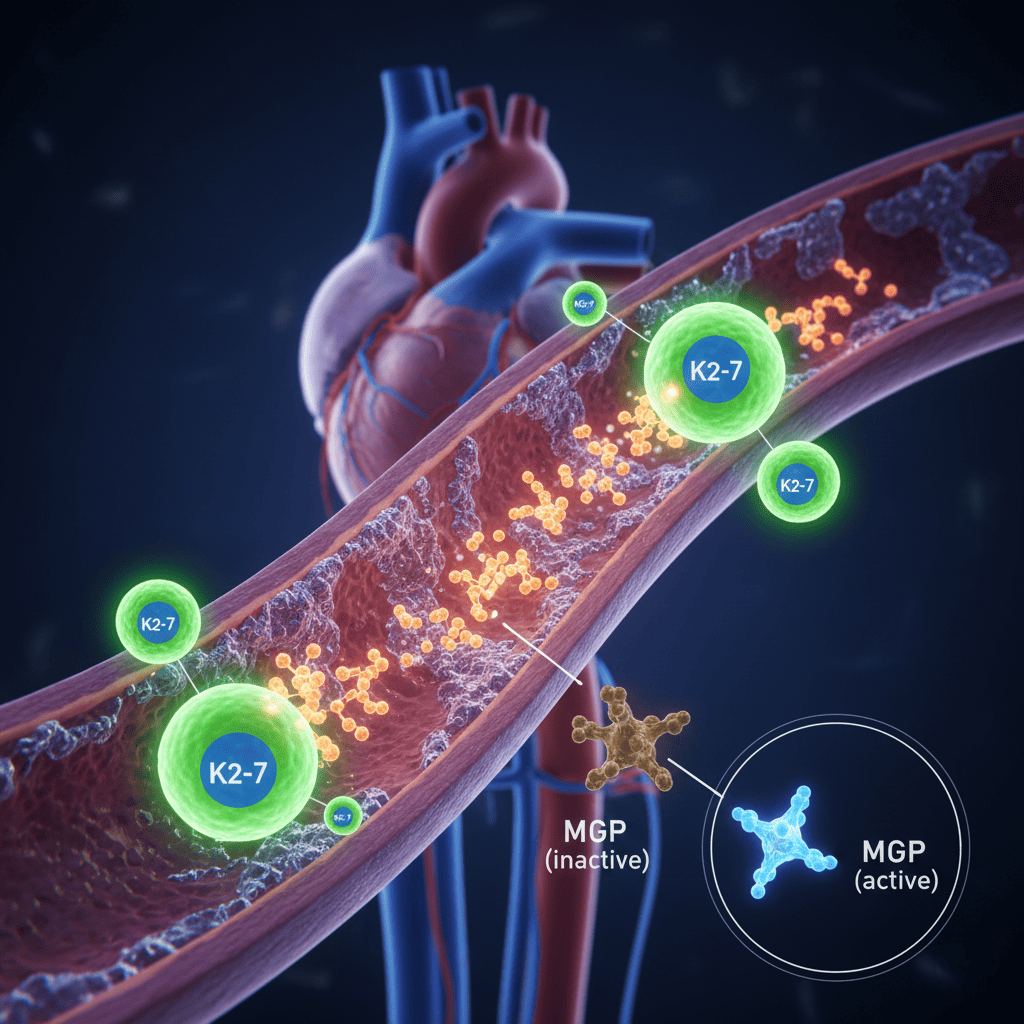
Yes, you do have an advanced immune system in your body to help protect against an invasion of calcium. This immune system is known as the matrix gla protein (MGP), which is responsible for directing calcium away from your soft tissue and into your bones (where it should go).
What makes this even more interesting is that vascular smooth muscle cells and the cells surrounding your joints create MGP, which is named “the most significant known natural inhibitor of mineralization in soft tissue” (PMC, 2012). MGP, when it is healthy, binds with calcium crystals and prevents them from creating dangerous deposits in your cartilage, tendons, and ligaments.
The problem is that MGP can only do its job when it is activated (in a process known as carboxylation); MGP can only be activated by vitamin K.
The significant importance of MGP is shown by studies on animals that have been genetically altered not to make it, the mice developed calcification of the growth plate of the cartilage and other large arteries, and this led to death from both of these causes within 6-8 weeks (PMC, 2012). In the same way these researchers created a vitamin K deficient model in normal mice (by giving them warfarin but keeping their liver functional), and the same tragic pattern of calcification occurred in all the soft tissues of these mice, including the did and all other soft tissues, including fat, organs, blood vessels and cartilage.
The concerning reality is that research indicates that many extra-hepatic Gla proteins, including MGP are only partially carboxylated in normal adults, which suggests a general vitamin K deficiency is relatively widespread as it pertains to the entire population (PMC, 2012). This suggests that the MGP of most people is only partially activated., making their joints susceptible to ongoing calcification.
How Terraquino’s K2-7 Restores the Balance?
That’s where Terraquino’s K2-7 becomes a key player in restoring joint health and tissue flexibility.
Although vitamin K1-phylloquinone found in leafy greens-is used by the liver to produce blood clotting factors, vitamin K2 and, more importantly, Menaquinone-7 (MK-7) have extrahepatic activity and a much longer half-life in the blood. This enables K2-7 to distribute and activate MGP within all of the soft tissues of your body, including all the vulnerable areas surrounding your joints.
There are several levels in how this functions:
Calcium-Traffic Controlling Activation: Vitamin K2-7 is a cofactor for an enzyme called gamma-glutamyl carboxylase, which converts inactive or uncarboxylated MGP to an active carboxylated MGP. Carboxylated MGP performs its important function of binding with calcium ions and inhibiting the formation of crystals within soft tissues (PMC, 2012).
Calcium Directing to Bone, not joints: To use calcium properly, K2 is necessary for activating both MGP and osteocalcin. MGP inhibits calcification of soft tissue while osteocalcin promotes the mineralization of bone. This combination ensures that calcium strengthens your bones rather than stiffens your joints (PMC, 2015).
Maintaining Tissue Elasticity: Clinical research shows that supplementation with K2 helps maintain the elasticity of your blood vessels long-term. In one study over a three-year period, those who received K2 supplementation maintained the elasticity of their arteries, while the placebo group experienced a 12% decrease in elasticity (PMC, 2012). The same principle applies to the elastin and pliability of the tissues in your joints, adequate K2 helps hold the natural elasticity/pliability of tendon, ligament and cartilage.
Reducing the Inflammatory Load: By preventing new crystal formation and potentially stabilizing current deposits, K2-7 can help reduce the inflammatory cascade created by calcium crystals within the joint spaces (Frontiers in Cell and Developmental Biology, 2022).
An impressive body of evidence supports the biomarker theory. For instance, levels of circulating desphospho-uncarboxylated MGP (dp-ucMGP) can be used as an indicator of the deficiency and even as a predictor of risk of calcification. Intervention studies on the effect of Vitamin K on MGP carboxylation show dose-dependent enhancement of MGP carboxylation in response to Vitamin K supplementation.
Prevention Is Your Best Strategy.
The best way to avoid soft tissue calcification is to act early, as once symptoms like stiffness, decreased range of motion, or an inflammatory flare have developed, much of the calcification has already occurred. Early prevention and intervention are much more effective at preventing calcification than treatment after calcification has occurred. The best way to prevent calcification is through proper vitamin K2-7 intake, as it has the following benefits:
- Activates your body’s defense system by helping to “carboxylate” Matrix GLA protein (MGP) and to continue to inhibit the crystallization of calcium.
- Maintains range of motion of the joints by preserving the elasticity of tendons, ligaments, and cartilage rather than allowing them to become stiff and brittle.
- Breaks the cycle of calcification by preventing further damage to the tissue and, thus, further calcification.
- Supports healthy aging by offsetting the critical physiological mechanisms that lead to decreased flexibility and function in a joint over time.
Take Control Your Joint Health Now:
If you experience joint creakiness and morning stiffness, they are not simply symptoms of old age but often the result of a natural process known as soft tissue due to calcium deposits developing on your bones, this problem can easily be helped through proper nutrition.
At Terraquino we have developed our K2-7 supplement using the best available dose, delivery system and active ingredient (K2-7), so you can activate your body’s Matrix Gla Protein to help hold calcium in the bone. Keeping calcium in your bones and out of the joints plays an important role in maintaining a good quality of movement and flexibility as we age, but last but not least it will be an important factor for preserving your freedom to be able to continue to live as you have for years past enjoyably.
Don’t wait until the stiffness limits you. Don’t suffer from feeling like your joints are older than they should be. Give your body the vitamin K2 that you need to ensure that calcium is placed directly into your bones where it belongs.