Life has many transitions. Your career grows and changes, your relationships advance, your dietary needs change with each new decade of life. But while all of these things change, there is one major requirement that’s surprisingly the same and the one thing that most people never think about at all.
Technology wise, you’re dealing with vitamin K2, the unknown vitamin that oversees some of the very fundamental things your body processes from cradle to grave. While your vitamin needs increase and decrease enormously throughout the course of a lifetime, your overall need for vitamin K2 remains surprisingly consistent. The thing is, however, you’ll never get enough of it to begin with.
Need for a Constant Is Changing.
What are your nutritional needs?
Necessarily, the nutrients contained in the body of an infant will vary from the nutrients contained in the teenager’s body. Obviously, the nutrient requirements of a pregnant woman will vary from a menopausal woman. The nutrient requirements of an athlete will vary from the nutrient requirements of a person who leads a sedentary lifestyle most of the time. We are not surprised by these facts since as our bodies change, so do the nutrients required by the body.
But here’s the rub: Vitamin K2 is different.
Keep this in mind while you read the research: although K2 has different specific uses at different stages of life, the significance of K2 has not changed from one generation to the next. Thus, whether you are an 8-year old or an 80-year old, K2 is essential for your body to activate several proteins that specifically affect the physiology of calcium metabolism, tissue health, and cardiovascular health (PMC, 2019).
Studies conducted to see how much K2 men’s and women’s bodies contain at various age levels show that 38.6% of pregnant women in their third trimester and 33% of newborns at birth do not have adequate amounts of K2 (VitaminExpress, 2024).
Childhood and Adolescence: Building the Foundation
Let’s begin with the beginning. As we all know, babies are born with very low levels of Vitamin K, which, by the way, is considered so dangerous that newborn babies are given Vitamin K injections at birth to avert Vitamin K Deficiency Bleeding Syndrome, a life-threatening disease (PMC, 2022).
But the thing that the average parent isn’t aware of is that the requirement for the K2 doesn’t stop there that it actually becomes amplified.
Why children have exceptional K2 demands?
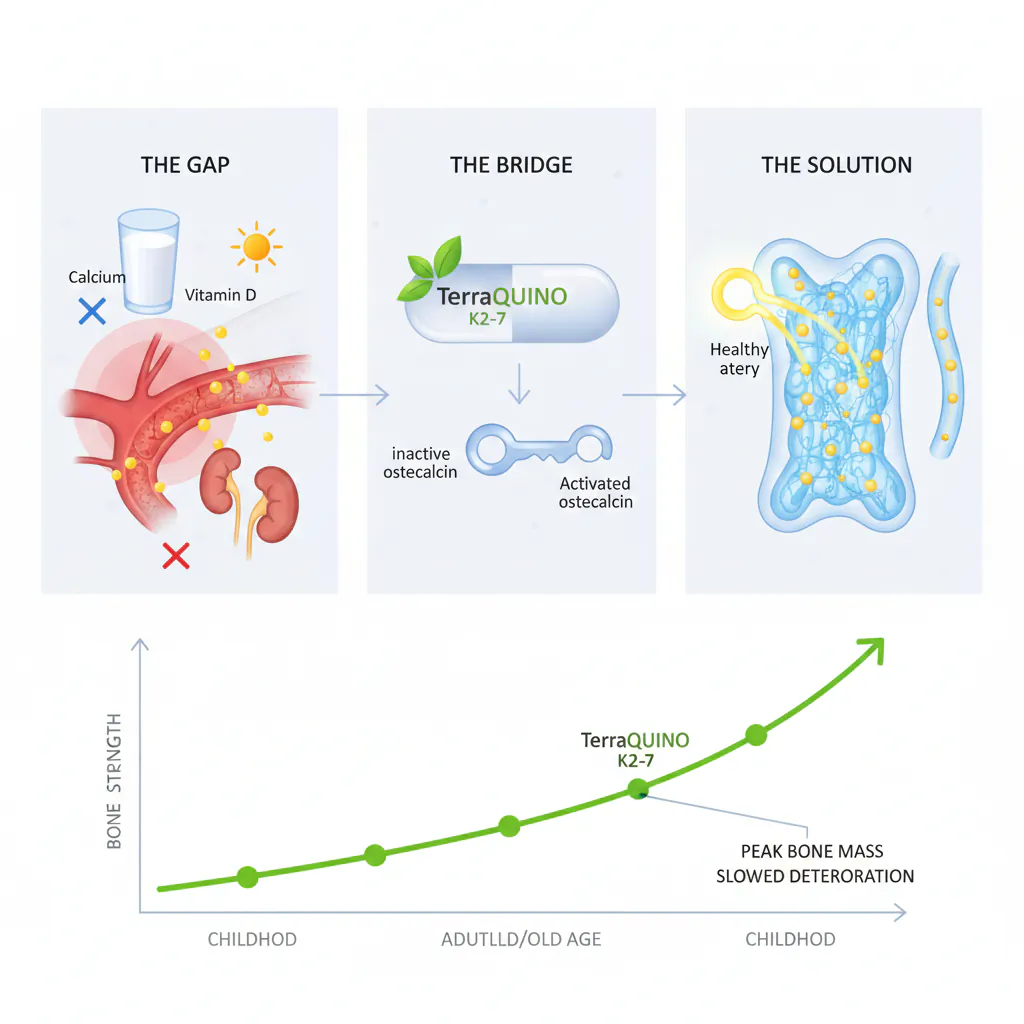
Osteocalcin, which is a vitamin K dependent protein used to bind calcium into the bone matrix, is present in children’s bones approximately 8-10 times greater than it is in adult bones (VitaminExpress, 2024). This difference is significant and one order of magnitude greater than that found in the adult bones. Adequate K2 levels are especially necessary for children during the crucial time frame of childhood and adolescence, a period of time in which children develop approximately 40-60% of their adult bone mass.
When researching healthy children, evidence suggests that the levels of inactive, or undercarboxylated, osteocalcin are much higher than those found in adults. This means that at a time when there is intense bone growth and formation, many children have insufficient levels of vitamin K (British Journal of Nutrition, 2009). Children with low vitamin K status also show lower average heights and have lower rates of accumulation of bone mass over time (Balchem, 2024).
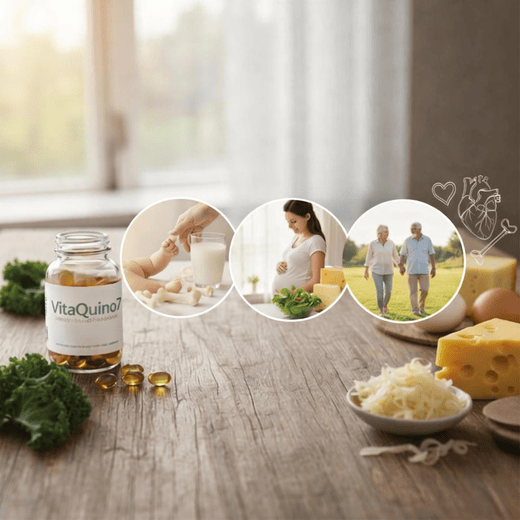
Considering the increased rate of processed foods consumed by the present generation, the contemporary children are deficient in the intake of vitamin K2, which is rich in foods such as fermented foods, egg yolks, or cheeses. A study conducted among the children of Hungary has shown a direct relationship between the level of vitamin K2 consumed by children and the variation of bone mineral density among 10- to 12-year-old children. (PMC, 2025)
In summary, if your child is consuming a breakfast cereal that provides calcium but does not provide K2, the calcium will not reach the developing skeleton.
Pregnancy and Lactation: Dual Demands, Limited Transfer
Clearly, pregnancy alters nutritional needs.
We know that pregnant women require extra calories, more protein, and extra amounts of folate and iron, etc. But sometimes there’s another, less appreciated layer of nutrition that’s at play.
Maternal vitamin K2 deficiency is surprisingly common in late pregnancy, with a prevalence rate of nearly 40% among mothers (PMC, 2025). Why is that so?
Pregnancy causes a substantial increase in K2 demand through several different mechanisms like hormonal factors, fetal bone formation, increased blood volume, and modifications in gut microbiome composition (PMC, 2025).
And here is the catch: Vitamin K2 from the mother to the fetus is very restricted. Science has pointed out that while Vitamin K2, specifically MK-4, is indeed transferred from the mother to the child, only in limited quantities, the placenta carefully regulates the amount transferred to the baby, while the placenta stores the Vitamin K2, then slowly releases the said Vitamin K2 unto the baby (PubMed, 1989). Thus, the child will even still be Vitamin K2 deficient despite the mother’s status.
The consequences of a Vitamin K deficiency extend beyond a certain area:
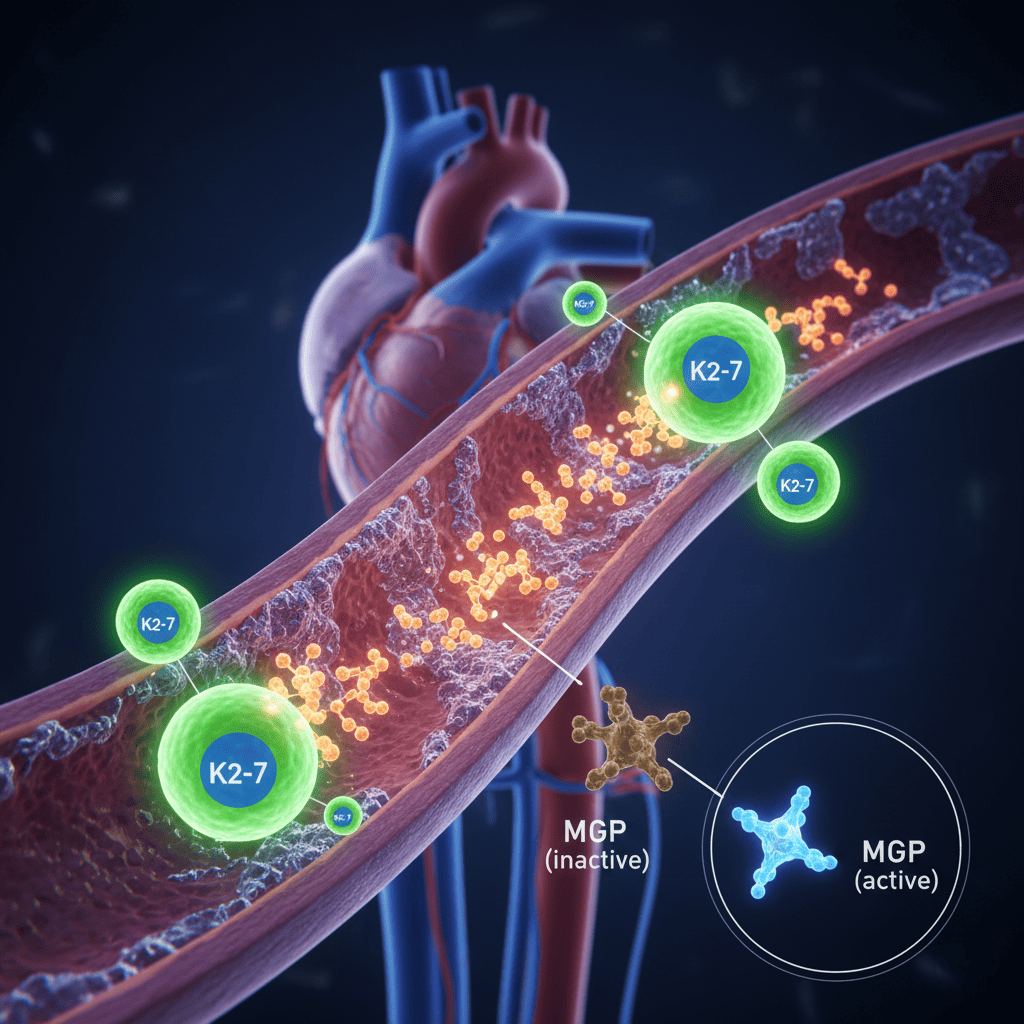
Maternal Impact: Due to the high calcium requirement of the developing fetus, there are increased demands on the mother’s skeleton to support the developing fetal skeleton. If the mother does not have adequate Vitamin K2 in her system and bone tissue is unable to properly utilize calcium, as well as activating MGP, the mother will suffer from both decreased bone density and increased calcification of soft tissues.
Fetal Impact: A lack of Vitamin K2 in a pregnant woman’s body (in the first trimester) can impair proper development of the structure of the baby’s face. MGP also requires Vitamin K2 for activation to maintain the normal, non-calcified, state of the nasal cartilage. Without the proper amount of Vitamin K2, calcification will occur too early, and as a result, the baby’s face will not develop to expected dimensions and there is a high likelihood of requiring orthodontic treatment (Rumina Naturals, 2019).
Impact on Newborns: With limited transfer of Vitamin K2 through the placenta and a low content of Vitamin K2 in breast milk, infants who are born to mothers with a Vitamin K2 deficiency will have little to no Vitamin K2 stores at the time of birth. Recent research has shown that there is a 33% prevalence of Vitamin K2 deficiency in neonates, and it is directly related to the mother’s Vitamin K2 levels (PMC, 2025).
Recent research (published in Food Science & Nutrition, 2025) has demonstrated that both maternal Vitamin K2 levels and newborn calcium levels are independent risk factors for Vitamin D deficiency, and both negatively impact bone metabolism in maternal and neonate.
Middle Age Transition:
Your 40s and 50s don’t come with the in-your-face nutritional needs that pregnancy and adolescence do, but the reality is, important shifts are happening in the background, and the importance of vitamin K2 to you is escalating, not falling.
Studies that looked at the biomarkers of the vitamin K2 status showed that adults above the age of 40 show a large degree of deficiency, ranking them as the most K2 deficient, apart from children (VitaminExpress, 2024). This is, however, not coincidental, as middle age is the time of life when the onset of age-related bone loss, cardiovascular calcification, and the maintenance of the protective mechanisms your body developed as a child start to require more maintenance.
What’s happening in your body:
Around age 30-35, bone mass peaks and then begins a gradual decline that continues throughout the rest of life. For women, this decline accelerates dramatically during and after menopause when estrogen levels drop. For men, the progression is more gradual but equally relentless.
Without adequate K2, several concerning processes unfold simultaneously:
Insufficient K2 to activate osteocalcin: Middle-aged individuals have been demonstrated to carry an abundance of inactive osteocalcin compared to younger people, implying a lack of K2 for its activation (PMC, 2024).
Soft tissue becomes calcified without warning: While calcium is lost in the bone, soft tissue (blood vessels, joint cartilage, etc.) accumulate excess. Investigations into cartilage calcification show age is the greatest factor in its depositions; while all specimens studied had deposits of calcification in the cartilage, there were many less than in those samples that were over forty (PMC, 2007).
Heart disease risk increases: Cross-sectional studies show a correlation between blocks of coronary arteries and K2 consumption, whereas traditional vitamin K1 does not yield that same relationship (PMC, 2020). Those who participated in the Rotterdam Study (4,807 people aged 55+), for more than seven years, exhibited 41% lower risk of heart disease and 57% lower mortality from heart disease when they consumed larger quantities of menaquinones (Nutrients, 2021).
The issue with middle age is that these events occur over long periods of time, often years before we experience symptoms. Usually by the time we realize that we have stiff joints or receive abnormal test results from our doctors, we have already sustained substantial calcification emitted from the soft tissue and / or arteries.
The Elderly Years: When Prevention Meets Reality
If vitamin K2 is important throughout our life span, it is absolutely critical in our later years no more or less so than that, despite the fact that the physiological processes remain the same, simply because decades of vitamin K2 deficiency add up to clinical consequence.
Osteoporosis and cardiovascular calcification embody two of the most significant public health challenges that commonly co-occur within the elderly patient group. Osteoporosis and cardiovascular calcification impact ‘quality of life’ and ‘mortality risk’ equally. Osteoporosis and cardiovascular calcification were regarded as separate but associated events with increasing age for many decades. Now it has been recognized that ‘these disorders are closely interrelated processes mediated by “bone-vascular crosstalk,” with vitamin K2 deficiency being the common link between them’ (Nutrients 2021).
The “calcium paradox” in aging:
As it relates to aging and called the “calcium paradox,” think of the calcium in your body like a checking account. When you are young, provided you have enough vitamin K2 in your diet, calcium will flow into your bones – the “savings account” for bones – rather than leaking out into the cartilage or blood vessels – the “spending areas” for calcium. However, when there is a deficiency of K2 (particularly if it has existed for many years), this calcium flow reverses; calcium begins to leak out from the bones (the area of your body where you need calcium the most), and instead, deposits in your blood vessels, cartilage (particularly joint cartilage) and heart valves (causing significant damage).
Research has demonstrated that women older in age, those who have lower amounts of vitamin K in their blood, as well as those that show higher amounts of undercarboxylated osteocalcin, which acts as a marker for inadequate amounts of vitamin K, are at an increased risk of fractures of the hip” (PMC, 2024). In addition, women older in age with lower amounts of vitamin K in their blood, as well as higher amounts of undercarboxylated osteocalcin, are commonly linked with significant calcification in their vascular systems, or their blood vessels, as well as a stiffening of their arteries, also known as decreased elasticity in their arteries, along with an increased risk of death from cardiovascular disease.
The intervention opportunity:
Here’s the encouraging news:
Vitamin K2 can be beneficial even in older adults. A group of studies using meta-analysis to study those in Japan has concluded that there are some very strong indications that taking vitamin K2 plays an important role in maintaining bone mineral density, reducing postmenopausal women with osteoporosis from developing hip fractures, and potentially improving the quality of life for seniors with osteoporosis. A high dose (45 mg daily) appears to be safe and effective for postmenopausal women who are being treated for osteoporosis.
A landmark three-year randomized clinical trial demonstrated that vitamin K2, given as MK-7 at a daily dose of 180 mcg, not only suppressed age-related arterial stiffening but even produced a statistically significant improvement in vascular elasticity in healthy postmenopausal women. What’s more, this wasn’t just a matter of preventing further deterioration; this was actually the reversal of established stiffness.
Additional studies demonstrate that supplementation with at least 100 mcg of MK-7 can positively affect bone metabolism and decrease undercarboxylated osteocalcin in elderly subjects. In a study involving 29 elderly patients with osteoporosis who received 45 mg/day of MK-4 for 12 weeks, no adverse hemostatic effects were reported, even though plasma K2 levels were significantly increased.
Why K2-7 is the Form That Matters Across All Ages?
Not all vitamin K2 is the same and it’s an important distinction when you’re thinking about lifelong health. There are several forms of vitamin K2, labeled as MK-4, MK-7, and so on, up to MK-13. However, MK-7 (menaquinone-7) stands out for several critical reasons:
Extended half-life: The half-life of MK-7 is extended. This leads to a greater utilization of the different tissues outside the liver, including bones, blood vessels, and soft tissues. (PMC, 2019)
Superior bioavailability: Research has proven that compared to vitamins K4 and K1, tissue saturation is better and the level is more stable with MK-7.
Optimal Dosing: Even though research on MK-4 utilized very high doses (45 mg per day), research reveals that MK-7 is just as effective, if not even more so, with much smaller dosages (100-180 mcg per day).
Consistent Efficacy: From the development of bone in the pediatric patient to cardiovascular benefit in the elderly patient, MK-7 has repeatedly demonstrated efficacy as a vitamin K dependent activator.
The Terraquino Commitment to Lifelong Health:
At Terraquino, we recognize that optimal health isn’t built in isolated moments—it’s constructed through consistent, intelligent nutritional support across every life stage.
Our K2-7 supplement delivers the precise form and dose of vitamin K2 that scientific research demonstrates as most effective:
For growing children and adolescents: To support intensive periods of bone formation during which osteocalcin is at its lifetime peak, we must provide calcium to developing bone structures instead of allowing it to accumulate improperly.
For women who are pregnant and nursing: We need to provide vitamin K2 to meet the increased needs associated with pregnancy, while also maintaining maternal bone health and fetal development, even with limited amounts of K2 being transferred through the placenta.
For middle-aged adults: We must activate MGP to help prevent the silent accumulation of calcification in soft tissues, which increases during this period, while preserving bone density through the natural onset of loss.
For older adults: We want to provide for the documented cardiovascular and bone health benefits of vitamin K2 that will help enhance quality of life, minimize fracture risk and allow for healthy aging.
The beauty of K2 is that it is consistent throughout the entire lifespan from when we are 8, to 38, to 78, the specific use of K2 may change, but the fact that we need K2 does not.
Most individuals are K2 deficient for their entire lifetimes without realizing it. Symptoms do not appear until decades after a deficiency is established; for example, an osteoporosis diagnosis at age 65, an arterial calcification discovered during cardiac testing, or joint pain that prevents one from completing daily activities.
So, don’t wait for symptoms to address a deficiency. The optimal time to ensure adequate K2 is always, at every age, throughout your entire lifespan.