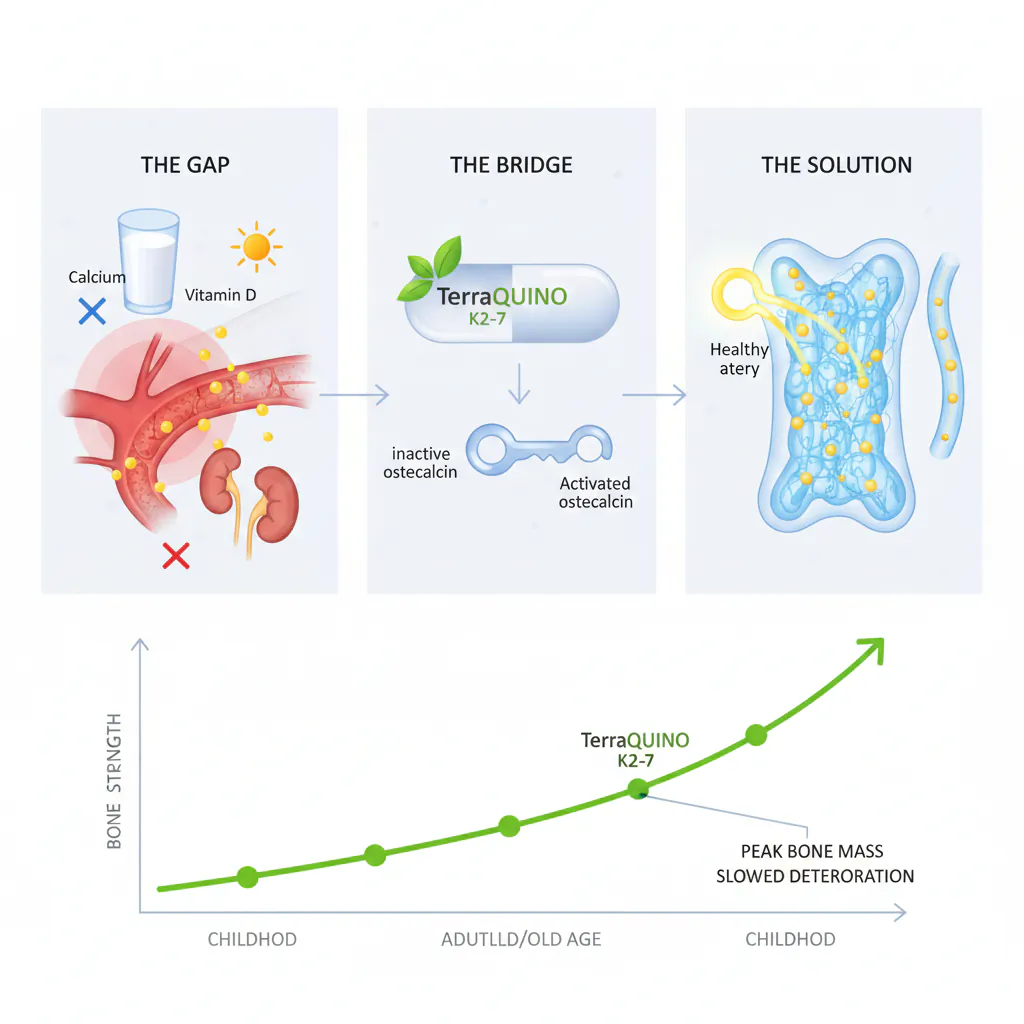
During childhood and adolescence, your body is making decisions that will happen only once in a lifetime regarding your bones. By the late teens to early twenties, you solidify what’s called your peak bone mass i.e. the highest strength and density your bones will ever achieve.
Each gram of mineral bone placed in the right location during this time period earns interest for the rest of your life. But here’s the thing, you can’t make deposits later in life. After that window is closed, it’s no longer about building bone mass but simply preserving what’s left.
This is why nutrition and biology in adolescence are so much more important than we were ever told. It’s not just about getting enough calcium or drinking a glass of milk a day. It’s about whether the body had the complete biochemical toolbox to actually put the minerals in the right places to actually put them deep into the bone structure. If that wasn’t an efficient process, the chance is lost, and it’s lost forever.
This is why osteoporosis is a completely different story when you look at it from this perspective. Osteoporosis doesn’t begin in old age instead it begins decades earlier, when the foundation is still being laid.
The Critical Window You Can’t Rewind
Picture this.
Right now, during the adolescent stage of your life, your body is laying down more bone than at any other time in your life. Approximately 40% to 60% of an adult’s total amount of bone accumulation occurs during the adolescent years (Journal of Pediatric Orthopaedic Society of North America, 2024). Even more staggering is that approximately 25% of the total peak amount of bone accumulated in the body occurs during one of the two years surrounding the adolescent growth spurt itself (PMC, 2016).
This time period is critical and it’s a time period you can’t go back and recreate. When girls reach age 18 and boys reach age 20, they will have reached approximately 90% of their total peak bone mass (PMC, 2010). Therefore, when this critical window closes, any future increases in bone density will result from the foundation of bone density laid during the critical time period. As stated by bone health experts, “Senile osteoporosis begins as a pediatric disease” (PMC, 2012).
Think about that for a second. The reason your grandmother will likely have osteoporosis at 75 years of age is the preparation she did, or didn’t do, during the teenage years.
Here’s where it gets concerning:
Most teenagers in this country are not going to reach their genetic potential for achieving peak bone mass, and this problem is serious because these years will determine if a person will have a strong bone structure for a lifetime. What is the reason for this? There are many; however, the most important reason is that not enough nutrition is consumed during this important time period in their development.
In young people, there is something else of concern; there is a lot of undercarboxylated (inactive) osteocalcin present when compared to adults, which means that children are not receiving enough vitamin K. We know from various research studies that vitamin K is critical for bone formation and that children do not have adequate amounts in their system to provide the nutritional foundation needed for maximising their skeletal structure during this critical stage of development.
Why is this so important?
Think about the math involved in bone density.
Every 10% improvement in your peak bone mass will lower your chances of osteoporotic fractures by 50% in the future. However, children who do not work on maximizing their peak bone mass will be faced with a series of consequences:
Short-term consequences: During the rapid growth spurt of adolescence, the rate of growth exceeds the rate of bone mineralization. This leads to a temporary period of skeletal susceptibility, which is why the rate of fractures actually peaks during peak height velocity in adolescence (Journal of Pediatric Orthopaedic Society, 2024).
Long-term consequences: Peak bone mass is lower, so there is less “reserve” to draw on when bone loss begins with aging, usually around age 30. People with suboptimal bone density reach critical thresholds for osteopenia and osteoporosis several decades earlier than they should.
Economic consequences: The estimated economic impact of osteoporosis-related fractures in the United States is predicted to be $25.3 billion a year by 2025 (PMC, 2010). Most of these fractures could have been prevented by proper nutrition during adolescence.
The Science Behind Strong Bones:
Your skeleton is not a static storage place for calcium but instead is a much more active, living entity controlled by very complex biological systems. At the heart of the development of bone is an extraordinary protein known as osteocalcin.
Osteocalcin is produced by osteoblasts (bone forming cells) and acts as the molecular adhesive that connects calcium to the mineral matrix of bone. However, osteocalcin needs an activation step called carboxylation before it can become an effective molecule. This carboxylation process is dependent on adequate supplies of vitamin K2.
Two studies on healthy children prior to puberty, who received modest amounts of menaquinone-7 (MK-7, the most bioactive form of vitamin K2), demonstrated a marked increase in plasma levels of MK-7 and also a significant increase in the levels of osteocalcin that had participated in the carboxylation process within 8 weeks (British Journal of Nutrition 2009). This change was not minor; rather, it was a measurable increase in the ability of the body to build bone tissue during a time when bone formation potential is maximized.
The implications are profound. It has been found that bone metabolism needs 155-188 μg of vitamin K per day, which is much higher than the 62-54 μg required for blood coagulation. However, the studies on dietary intake have shown that most adolescents fail to meet this requirement, thereby leaving a substantial portion of their osteocalcin in the inactive form.
How Terraquino’s K2-7 Fills the Gap?
It is exactly here that the Terraquino’s K2-7 dietary supplement makes all the difference in the world for young people’s bone health.
While the vitamin K1 present in high amounts in leafy vegetables (such as spinach) is mainly involved in blood clotting, the vitamin K2, particularly in the MK-7 compound, has a distinct biological activity that is tailor-made for bone health. The MK-7 compound has an extremely long half-life in the bloodstream, which makes it better suited to reach target tissues outside the liver, such as the bone, compared to vitamin K1 (Journal of the American College of Nutrition, 2017).
The mechanism is simple yet powerful:
Using Terraqino’s K2-7 can be beneficial for adolescents’ skeletal development because it provides their bodies with the needed cofactor to convert inactive osteocalcin to its active form i.e. carboxylated osteocalcin.
Carboxylated osteocalcin has a vital role in bone mineralization by binding calcium ions to hydroxyapatite crystals in the bone matrix, establishing the foundation for lifelong skeletal integrity.
The literature supports this practice. A longitudinal study of 307 healthy participants demonstrated that vitamin K sufficiency during adolescence is positively associated with attaining optimal peak bone mass (PMC, 2016). In addition, children with insufficient vitamin K status also had below average height and accumulation of bone mass (Balchem, 2024).
There also appears to be a good level of safety for MK-7. MK-7 has been shown to be safe in children and adolescents with no established upper limit due to the finding of no toxicological data on MK-7 (Nutritional Outlook, 2024). Research supports that MK-7 can improve bone marker levels without negatively impacting coagulation factor levels even at supplemental doses.
The Investment That Pays Lifelong:
Think of your peak bone mass as your financial investment for bones, there’s only a set amount of time (adolescence) to build your peak density versus years to accumulate a large sum for retirement. If you wait until after you’ve completed your time (centered around age 29 for girls and 35 for boys), you will not be able to fill in the gap you have missed (assuming that you filled your investment cans with money when you were contributing to their build).
By adding Terraquino’s K2-7 during the critical years of bone development, you’re doing the following:
- Activating osteocalcin to maximize the body’s natural peak bone-building potential
- Building a strong foundation that will protect against bone loss in your 80s, 90s, and beyond
- Providing targeted nutrition during a time when 25% of lifetime bone mass is accumulated in just 24 months
- Every percentage point of peak bone mass translates to a significant reduction in lifetime fracture risk
The best part about this strategy is its simplicity. You can’t change your genetics or go back in time, but you can give your body the best nutrition during the natural window of bone development.
At Terraquino, we know what we’re talking about when it comes to the biology of skeletal development, and we’ve developed our K2-7 supplement to provide exactly what developing bones need most, highly available and long-acting vitamin K2 in the MK-7 version that turns on osteocalcin at the right time and in the right place.