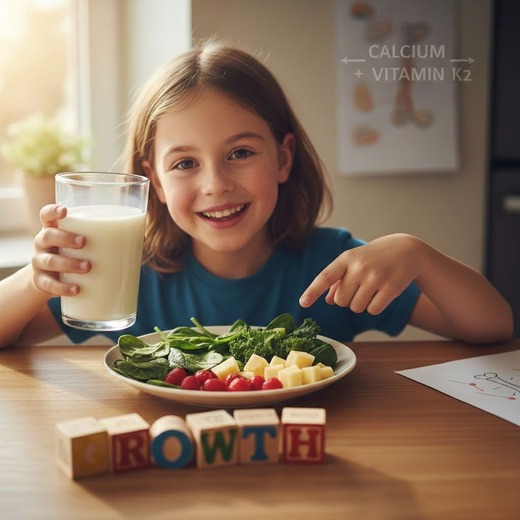
“Your child may be drinking milk with every meal. He may be eating yogurt for snacks too. You might’ve checked all the right boxes in terms of calcium consumption.” But there is one important question that parents rarely ask: “Is the calcium even getting to the bones?”
Fact is that absorbing calcium and using calcium are two completely different things. And during the most important age for bone development especially among children, most kids are failing at the latter even as they’re succeeding at the former.
The Gap Between Eating Right and Growing Strong:
During the first 2 years of your child’s early adolescent development stage (the pubertal period), approximately 25% of your child’s total peak bone mass will be formed. This means that almost ¼ of the child’s entire skeletal foundation was formed in 2 years. The rate of bone mineral development will never again be so rapid during their life.
Research studies demonstrate that healthy children have much higher levels of inactive (undercarboxylated) osteocalcin than adults, which is a result of widespread vitamin K deficiency within the same time frame as children’s highest level of bone development. This means that the child’s body is trying to produce bone, but cannot use the calcium in their diet without sufficient vitamin K.
This is especially challenging because low calcium intake during childhood can lead to greater incidence of fractures and rickets and can prevent a child from developing their adult skeletal mass. It isn’t only low calcium intake that is the problem, but it’s also low absorption and use of calcium. Even when children consume adequate levels of calcium (>300 mg/day), the incidence of not achieving peak bone mineralization is high.
Why Calcium Alone Isn’t Enough?
Parents obsessively count how much calcium their kids get. They want to make sure they get 1,300 mg a day. While calcium is necessary for building strong bones, it serves only as one of the ingredients. Without the proper activation system for calcium, it would be like trying to build a home using nothing but bricks. Cement is necessary to hold all of the bricks together.
There have been many studies showing that the development and health of our bones largely depends on our body’s calcium needs. Calcium is the major mineral found in bone. The time period that is most critical for building a strong skeletal (bone) system is during childhood, particularly during early puberty (PMC, 2021). There are many reasons that prevent the body from using its calcium stores.
Dietary Interference: When spinach and dairy are consumed together, the oxalates contained in spinach restrict the body’s ability to absorb calcium from both foods. A diet that is high in fat creates a situation where calcium complexes with fatty acids and cannot be digested. Approximately 28% of the diet should be made up of fat for the body to absorb calcium properly. When fat levels exceed 45%, calcium cannot be absorbed in the intestines (CC in Endocrinology, 2021).
Insufficient Activation Proteins: Osteocalcin is the protein that binds calcium to bone tissue. Osteocalcin has three vitamin K dependent carboxyglutamic acid sites on it. In order for osteocalcin to be able to bind to calcium and create the proper structure in bone, a compatible amount of vitamin K2 must also be present (Journal of Bone and Mineral Metabolism, 2001).
Increased Need for Vitamin K2: Children have 8-10 times more osteocalcin than adults because they are rapidly building bone during childhood. This results in a substantial increase in their need for vitamin K2 compared to the amount typically found in their diets (Vitamin Express, 2024).
This has very real and obvious implications. In a study assessing Chinese youths over a period of time, adolescents whose calcium intake was under 327 mg/day showed reduced stature as adults. This is a lifelong, irreversible effect (Scientific Reports, 2017). Perhaps most alarmingly, increases in vitamin K status over 2 years were correlated with significant increases in bone mineral density in healthy children (British Journal of Nutrition, 2009), implying that children live in a chronic state of K2 insufficiency and are not reaching their genetic potential.
This is where Terraquino’s K2-7 transforms childhood nutrition.
Vitamin K2 (MK-7) is the most usable form of vitamin K2 in our body. Therefore, it is considered the essential co-factor for activating osteocalcin. In a landmark study involving healthy children prepuberty (British Journal of Nutrition, 2009), taking only 45 micrograms/day of MK-7 for 8 weeks increased the carboxylation of osteocalcin significantly and helped get more calcium into their developing bones.
How does MK-7 do this? It works simply by converting inactive (undercarboxylated) osteocalcin to the active carboxylated form of osteocalcin. Activated osteocalcin performs its most important function i.e. binding calcium ions to the bone mineral matrix and mineralizing the skeleton.
Why is MK-7 the form of choice?
Because of its long half-life, MK-7 can reach the bones, which are not primarily a blood clotting site. Therefore, MK-7 stays in circulation longer, produces more activity, and contributes to bone health more than vitamin K1 (found in green leafy vegetables).
Recent meta-analyses confirm what was suggested by individual studies. There was a statistically significant reduction in ucOC levels in the subpopulations defined by K1 and K2, by doses of ≤ 1 mg/day and > 1 mg/day, and by intervention durations of ≤ one year and > one year (Bone Joint Research, 2024). In summary, this data demonstrates that benefits are dose-dependent, duration-independent, and highly similar across a large number of populations.
The Window That Won’t Reopen:
The most important thing parents need to know is that kids cannot regain childhood opportunities to build their bones once they’re gone. By the time girls reach the age of 18 and boys reach the age of 20, about 90% of a person’s peak bone mass will have been developed. If children miss this opportunity, they will enter adulthood with a severe defect in their skeleton, and there is nothing they can do to ever fully recover from that defect throughout their entire life.
Studies have also shown that each time a youth increases their peak bone mass by 10%, it will reduce their risk of having an osteoporotic fracture later in life by roughly 50%. Children who do not reach their peak bone mass during youth will be at an increased risk of fractures for the remainder of their lives, and there is nothing that adults can do to fully recover from those risks through supplementation.
As a parent providing K2-7 to your child during critical growth years, you are:
- Maximizing the efficiency of calcium. For example, ensuring that all of the milk and yogurt that the child is consuming, turns into actual mineralization in their bones.
- Activating the body’s molecular machinery which will ensure that osteocalcin will remain in a functional and carboxylated state so that bones will be created.
- Creating irreplaceable foundations for your child’s bones. About 40-60% of the adult skeletal mass will be created during adolescence.
- Establishing skeletal reserves that will establish protection from osteoporosis and osteoporotic fractures at age 50 or older.
At Terraquino, we understand that childhood nutrition isn’t just about feeding your kids today in fact it’s more about protecting their health for decades to come. Our K2-7 supplement delivers the precise form and dose that clinical research demonstrates as most effective for activating osteocalcin during critical growth periods.
Don’t let poor mineral utilization sabotage your child’s genetic potential. The calcium they’re consuming deserves to reach their bones. Because you can’t go back and rebuild a foundation that was never properly constructed in the first place.