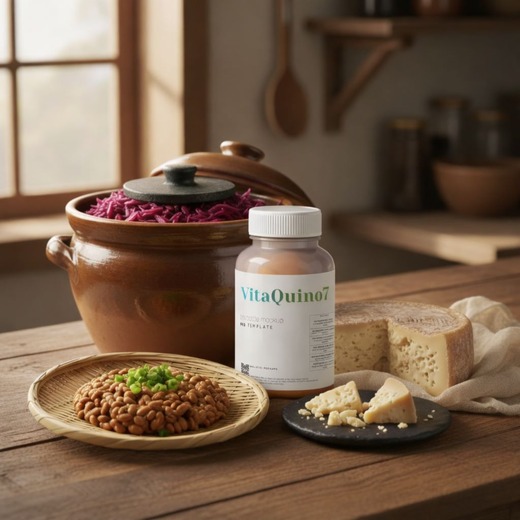
Your great-grandmother’s kitchen looked different from yours. Not just the appliances or the décor but the food itself. Her pantry held crocks of sauerkraut fermenting in the corner, aged cheeses wrapped in cloth, and foods that had been deliberately cultured by bacteria over days or weeks. She wasn’t trying to be healthy or trendy. She was simply eating the way humans had eaten for thousands of years.
Then something shifted. Refrigeration arrived. Food processing exploded. Convenience became king. And in the transition to our modern, sanitized food system, we accidentally removed one of the most critical nutrients from our daily diet i.e. vitamin K2.
The Fermentation Gap in Modern Eating
Vitamin K2 isn’t like other vitamins. You won’t find it in fresh fruits or leafy greens. It’s synthesized almost exclusively by bacteria during fermentation (Cleveland Clinic, 2023). This means that historically, humans obtained K2 from two primary sources: fermented foods like natto, sauerkraut, and aged cheeses, and from animals that consumed grass rich in K1, which their tissues converted to K2 and stored in fatty cuts of meat, organ meats, and dairy products.
The modern diet, one that’s being manufactured on an industrial scale is severely limiting access to the traditional sources of natural menaquinone that existed before the introduction of packaged food items (NYrture New York Natto, 2020). Traditionally, most cultures around the globe featured probiotic fermented living foods as an integral part of their respective culinary traditions. Kimchi in Korea, natto in Japan, and aged cheeses in Europe were not only used as a means of preserving food, but they could also be viewed as major vitamin K2 sources since they contained long-chain menaquinones (particularly, MK-7, MK-8, and MK-9) created through beneficial fermentation bacteria.
Today, however, the majority of people in America are eating pasteurized, shelf-stable products that have little-to-no viable bacterial activity. Of the more than seventy national food database systems, there are less than twelve (and just three databases) that report vitamin K content, let alone an indication of the concentration (IntechOpen, 2017). Consequently, vitamin K2 has been almost completely erased from our nutritional awareness.
This decline in fermentation is more than simply the loss of fermented vegetables. The same trends that transitioned most meat and dairy-producing animals from pasture-raised to the industrial grains based on factory farming systems have also resulted in the elimination of access to vitamin K1 from the grasses they used to graze; this was the precursor to these animals producing MK-4 in their tissues. Therefore, not only has the loss of access influenced our intake of fermented foods, but we’ve also not been eating as much K2 from meat or dairy products as we did prior to these transitions.
The Health Consequences of What We Lost
This isn’t just nutritional nostalgia. The absence of K2 in modern diets has measurable health consequences. Research confirms that widespread vitamin K2 deficiency has become a global health issue over the past century, with substantial portions of Western populations exhibiting undercarboxylated extrahepatic proteins—scientific proof that K2 intake is insufficient for proper bone and vascular health (Wikipedia, 2025).
Vitamin K is consumed from two different sources: K1 from vegetables, and K2 from animal products. The Western average diet generally contains approximately 90% of K1 and about 10% of K2 (WebMD, 2024). However, Vitamin K1 (phylloquinone) is responsible primarily for aiding in blood clotting by working with the liver, while Vitamin K2 (menaquinone) activates several different proteins (particularly osteocalcin in bones and Matrix Gla Protein MGP) throughout the entire body.
Research studies have revealed that increased dietary intake of vitamin K2 is generally associated with reduced prevalence of calcified coronary arteries and overall lower risk of developing coronary arterial disease. There is no evidence to support the fact that there is any relationship between increased dietary intake of vitamin K1 and the development of coronary heart disease (Medical News Today, 2023). Moreover, it was revealed in one research study that the risk of death from heart disease was reduced by 9% with each 10 µg increase in daily dietary intake of vitamin K2.
In support of the above-stated facts, the outcome of the Rotterdam Study indicates that combined focused nutritional supplements of menaquinones (vitamin K2) resulted in a 41% reduction in the development of coronary heart disease cases, and, simultaneously, a 57% reduction in the overall number of deaths due to cardiovascular diseases, after the population under study (approximately 5,000) was closely followed for a period of more than 7 years.
Because K2 is inadequate, the proteins responsible for directing the calcium to the bones rather than giving way to deposits in the arteries only get partially activated. Consequently, a majority of those who live in the Western world are identified with a significant amount of undercarboxylated MGP and osteocalcin (i.e., this means their bodies have the capacity to manage blood clotting, but do not have enough K2 to protect their cardiovascular systems or mineralize their bones) (Wikipedia, 2025).
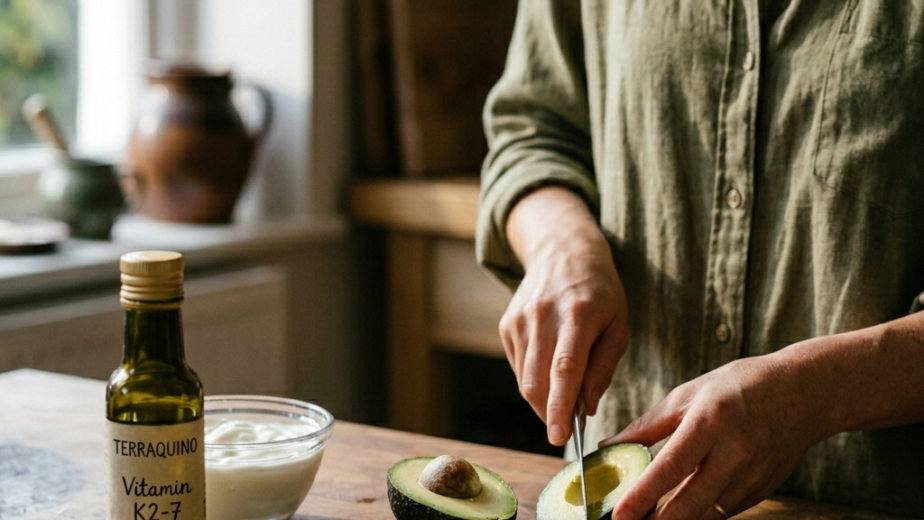
How Terraquino’s K2-7 Restores What Was Lost?
This is where intelligent supplementation becomes essential, not as a replacement for good nutrition, but as restoration of what modern food systems removed.
Terraquino’s K2-7 supplement delivers Menaquinone-7, the same long-chain form of K2 that traditional fermented foods like natto have provided for centuries. MK-7 is produced by Bacillus subtilis, the same beneficial bacteria used in traditional Japanese natto production, and it’s now the most employed microorganism at industrial level for producing dietary MK-7 supplements.
MK-7 is especially powerful due to its long half-life in the bloodstream compared to other vitamin K. Thus, it allows for greater tissue saturation in the body and allows for more consistent blood levels which in turn enable MK-7 to adequately supply the extra-hepatic tissues in the body where vitamin K dependent proteins are needed to carry out their essential functions, such as bone and blood vessel health.
In a systematic review of the literature on naturally fermented foods conducted between the years 1970-2024, review results indicate that vitamin K2 status was successfully improved in numerous studies with natto (fermented soybeans) and aged cheeses. The bioavailability of vitamin K2, however, can vary widely depending on the fermentation method and bacterial strain used to ferment the food (Frontiers in Nutrition, 2025). The understanding of what traditional cultures have developed over many centuries using fermented foods to provide nutrients in a form that is more readily bioavailable and therefore usable by their bodies has been supported by the current research on fermented foods.
What we are trying to do at Terraquino is not to make something new, but to reclaim something that has been lost in modern society. Our K2-7 product offers the same type of menaquinone that has been produced by bacteria for the last thousands of years, and we have developed a product that is bioavailable, consistent, and meets the needs of people living in today’s fast-paced world.
You can’t turn back the clock on food production systems. But you can reclaim the nutritional completeness that modern diets accidentally stripped away. Because what fermentation gave our ancestors for thousands of years, supplementation can give you today.