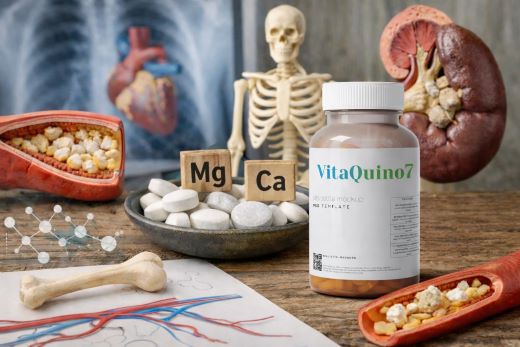
You’re 28. You feel invincible. Your blood pressure is perfect, your cholesterol is fine, and you just finished your first 10K run. You get a clean bill of health from your doctor. But right now, at this very moment, a process is happening inside your arteries that won’t manifest symptoms for 20 years, but will determine whether or not you’ll be having a heart attack at the ripe age of 50.
The reality is that the calcification process can begin as early as your 20s, but your healthcare provider won’t be able to diagnose it until there is a critical mass of calcification that shows up on their diagnostic tools. When you’re feeling symptoms such as chest pain, joint pain, and decreased flexibility, you’re not catching the disease early. You’re catching the disease late.
The March Toward Disease:
Atherosclerosis is a complicated process that takes place over several decades and speeds up in the last couple of decades of life. A key word to keep in mind here is “speed.” Speed means that something has already started moving. This process of atherosclerosis likely started decades ago when you were too young to be concerned about your cardiovascular health.
A calcium deposit can be very small (0.5 mm in size), but can grow as large as 3 mm in size with plaque continuing to develop. There is no single event in the process of developing atherosclerosis. This process is progressive and accumulates each year over multiple years. Evidence suggests that calcification occurs more linearly over several years instead of in acute episodes; this means every year you are deficient adds more layers to the issue.
The insidious part of this is that most people in their 20s and 30s do not have any reason to obtain images of their arteries. You are healthy, and your routine blood work does not show any issues. You do not experience chest pain or have shortness of breath and have no warning signs that something is wrong. But during that time, tiny calcium deposits are slowly entering into your arteries, joint cartilage and other soft tissues to lay the groundwork for the health issue you will experience in middle age.
Consider the timeline: A 25-year-old individual with suboptimal vitamin K2 levels will start to accumulate inactive forms of Matrix Gla Protein (MGP) and undercarboxylated osteocalcin. The body will be unable to properly channel calcium to the bones or prevent it from accumulating in the tissues. At age 35, there will be asymptomatic calcification in the vessels. At age 45, there will be stiffness in the arteries. At age 55, there will be a diagnosis of cardiovascular disease or osteoarthritis, a process that took 30 years to develop and will now dictate the rest of this individual’s life.
Why Silent Deficiencies Accumulate?
Vitamin K2 Deficiency is perhaps the most insidious nutrient deficiency due to its invisibility; whereas the lack or deficiency of other vitamins can produce significant visible consequences in a relatively short time frame (e.g., Vitamin C deficiency manifests with scurvy and Vitamin D deficiency can be detected by bone scans), K2 is often missed for decades.
There is research that demonstrates that undercarboxylated osteocalcin (the inactive form of osteocalcin) is an indicator of risk for hip fractures, and therefore elevated levels of undercarboxylated osteocalcin (indicating widespread insufficiency of K2) is common in our younger population (20’s – 30’s) and they are likely not monitoring their osteocalcin carboxylation status or the dp-ucMGP (dephosphorylated, uncarboxylated matrix Gla protein) levels that predict the risk of calcification in the future.
What is frequently not discussed are the common deficiencies of calcification inhibitors, such as fetuin-A and MGP, which promote calcification; and chronic low grade inflammation from aging, endothelial dysfunction from aging, and the decreased activity of natural inhibitors of calcification, such as MGP and fetuin-A – all of which serve as an independent risk factor for calcification due to the cumulative effect of many years of inadequate K2. Inflammation, endothelial dysfunction, and decreased activity of calcification inhibitors are not to be expected as we age; instead they are the result of decades of unrecognized formation from the vitamin K2 deficiency.
It has been demonstrated through research that vitamin K2 deficiency is widely prevalent, and that by addressing this deficiency, one can benefit from an improvement in overall health. There still has not been a set daily minimum requirement for vitamin K2, especially regarding any other functions of vitamin K2 beyond just blood clotting; these additional uses of vitamin K2 have not yet been studied enough or documented well enough to establish suitable levels for other functions of vitamin K2.
How Terraquino’s K2-7 Interrupts the Timeline?
Preventive nutrition can be very powerful. If you have calcified for 20 years, you cannot reverse that; however, you have the ability to stop anything from starting.
The K2-7 supplement from Terraquino contains Menaquinone-7, which is the most prevalent form of vitamin K2 and has the longest half-life and the highest bioavailability for tissues outside of the liver. When comparing K1 with K2-7 (Menaquinone-7), the K2-7 form has a much longer half-life, builds up in the blood better, and has a greater biologic activity.
When you take K2-7 in your 20s and 30s, you will begin the process of activating the proteins in your body that inhibit the calcification of your body. You will keep matrix g1p (MGP) in a functional state by ensuring that it is properly carboxylated. This means that you will ensure that osteocalcin can correctly bind calcium into the matrix of bone instead of allowing it to accumulate in arterial walls.
The mechanism for this is that K2-7 activates the body’s natural inhibitors of calcification so that they can do their normal protective job. Vitamin K2 prevents calcium deposits from accumulating at the wrong sites (e.g., soft tissue) and instead directs those deposits to the bones where they belong.
Prevention Is the Only Real Cure.
Billions of dollars and years of research have been dedicated to finding a cure for arterial calcification. The problem is that it is extremely difficult to reverse the process after calcium crystals have embedded themselves in the walls of your arteries and transformed the extracellular matrix into a bone-like environment.
However, preventing it is entirely possible.
By ensuring adequate K2-7 intake during your 20s and 30s, you’re:
Activating protective proteins: You’re keeping MGP and osteocalcin in active states for the years when silent calcification tends to begin.
Preventing the clock from starting: You’re actually preventing the microscopic calcium crystals from forming into a serious problem 20-30 years down the line.
Protecting all systems from a single point of attack: You’re not just protecting your cardiovascular health, but also your bone density, joint flexibility, and even cognitive function from a single compound.
Investing in your future self: You’re not waiting until it’s too late to worry about a problem and then trying to manage it.
At Terraquino, we know that the biggest health decisions aren’t dramatic decisions instead they’re the quiet, steady decisions made long before anyone would call them “necessary.” Our K2-7 supplement gives you the exact form and amount that science shows is the most effective at activating vitamin K-dependent proteins in your body.
Don’t wait until it’s time to deal with the symptoms of a vitamin K2 deficiency. The midlife health crisis doesn’t start in your 50s instead it starts now, in your 20s and 30s, with the silent nutritional gaps that build year after year. Because the health crisis you’ll face in your 50s is being created today, with every tiny increment of calcium buildup.