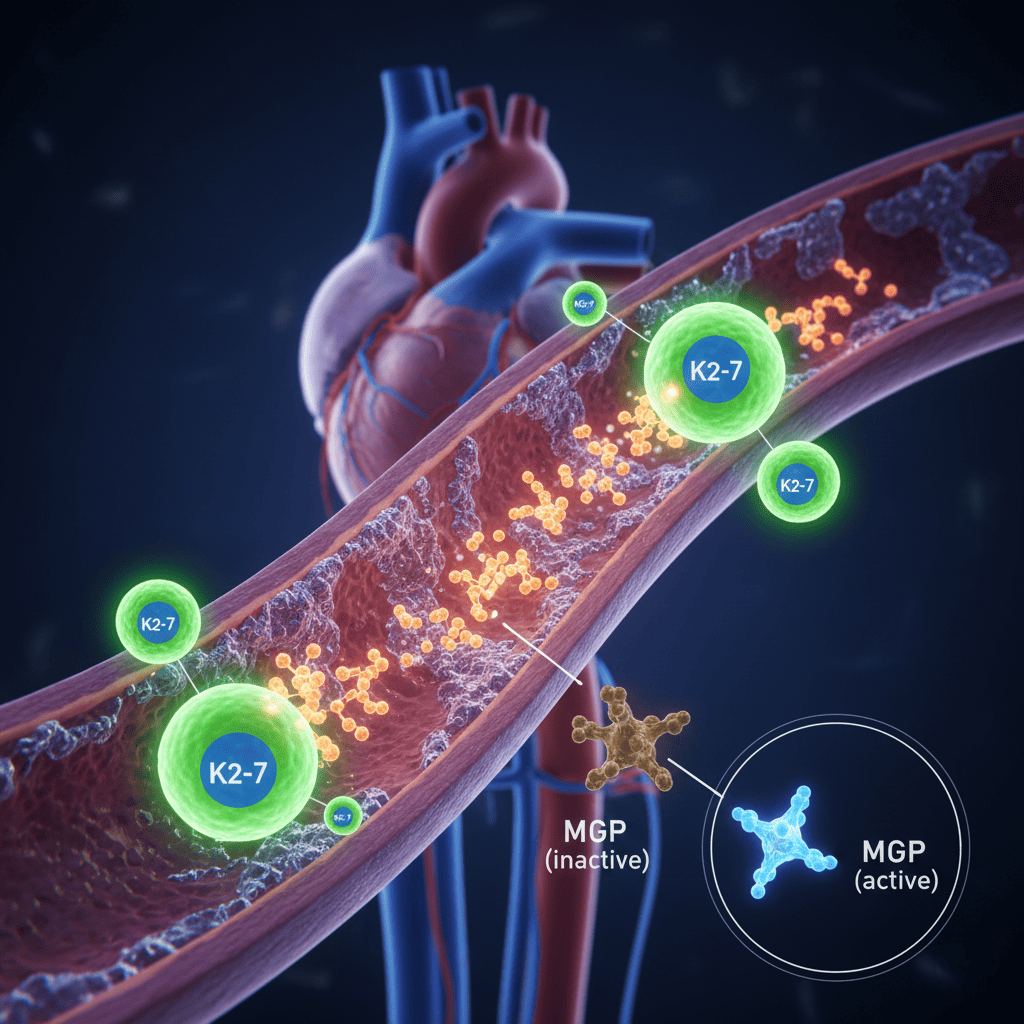
Calcium is a something we are advised to increase in our diet for our bones, teeth, and strength but when it goes in the wrong location, it quietly becomes a source of trouble. In the arteries, calcium doesn’t make its presence known with symptoms. There is no warning sign, no daily reminder. It builds up silently, hardening the walls of the arteries, making them less pliable, and forcing the heart to work even harder just to get the job done.
What’s particularly chilling about this is that it can occur even in individuals who feel perfectly healthy and are “doing everything right” taking their calcium, getting some Vitamin D, eating well. The problem isn’t calcium, it’s direction. Without the full regulatory system of the body in place, calcium can migrate from where it’s most needed (in the bones) to where it will do the most damage (in the arteries).
The Unseen Danger:
While vascular calcification may not be as sudden as a heart attack or a life-threatening medical emergency causing you to visit the ER, it is just as real and just as dangerous. As per the studies done by the American Heart Association (2018), it is now possible that most people over the age of 60 will have an increasing number of calcified deposits of calcium in their major arteries. However, many people do not realize that this process generally starts at age 20-30 years old and advances asymptomatically for many years, before you are aware of any problem.
A good analogy is the formation of rust on the inside of pipes. On the outside of the pipes you cannot see any problem, and the water will continue to flow until the pipe has received enough corrosion to become rigid and brittle. The most recent findings of the Journal of the American Heart Association (2018) confirm that this is precisely what is occurring in regards to “silent” calcification of the cardiovascular system due to calcium deposits causing stiffening of the arterial wall with no warning signs whatsoever.
The Devastating Consequences We Often Ignore:
“But I feel fine!” you might be thinking.
That’s exactly the problem.
Recent studies show that the prevalence of vascular calcification is about 24% in the general population, but it increases to over 90% in men and 67% in women over 70 years old. However, most people find out they have it when complications arise.
Calcium build-up in arteries causes:
- Less pliable arteries:Reduced resiliency of arterial walls creates more difficulty for the heart to force blood from the body into the lungs (via the pulmonary arteries) and will result in an enlargement of the heart (hypertrophy) which may ultimately lead to heart failure.
- Increase in cardiovascular mortality:Atherosclerotic plaques that exist within the coronary arteries provide an independent indicator of subsequent cardiovascular adverse events and high calcium score is associated with a significant risk of myocardial infarction (heart attack) approximately 7 to 10 times more than in individuals with zero calcium.
- Reduced supply of oxygenated blood:Because arteries become stiffer and smaller, the amount of oxygenated blood supplied to the different body parts diminishes, resulting in an increased incidence of hypertension, myocardial infarction, and potentially fatal (endangered vulnerable) limb conditions, as was found by research published in 2021 in the American College of Cardiology, indicating medial (in the wall) calcification of the coronary arteries was “highly predictive” of cardiovascular death” and had a greater impact than intimal (in the lumen) calcifications in patients with diabetes.
- Challenges with treatment: Calcified coronary arteries create difficulty in utilizing endovascular treatment techniques (such as stenting) and contribute to greater risk associated with performing any type of invasive surgical procedure.
Your Body’s Natural Defense:
Fortunately, you have a way to defend yourself from this silent invasion. Your body contains a powerful protective protein called Matrix Gla Protein (MGP) but there is a caveat.
MGP is an effective inhibitor of vascular calcification, however it must first be carboxylated by vitamin K in order for it to be able to exert the effects of inhibiting calcification (Nature Scientific Reports, 2020).
If there is not enough vitamin K in your body, MGP will not be activated, just like a security guard sleeping on the job. Research has shown that mice that are gene-deficient in MGP will die in less than 60 days due to widespread vascular calcification. Clearly MGP is critical to your vascular health. But the sobering reality is that low levels of vitamin K will result in the presence of inactive, uncarboxylated MGP & have repeatedly been shown to accelerate the process of vascular calcification (PMC, 2019).
How Terraquino’s K2-7 Activates Your Natural Protection:
Menaquinone-7 (MK-7) is the most active (metabolically available) form of vitamin K2 and has a long half-life in the body compared to the other forms of vitamin K such as vitamin K1, which is only found in green leafy vegetables. Vitamin K2 also has additional forms of action outside of the liver and is used by the body to activate matrix GLA protein (MGP), an important protein that helps prevent calcification of the vascular system.
In contrast to K1’s predominant function as a cofactor for proteins involved in blood clotting, K2 works by acting on proteins involved in vascular health. Specifically, K2 works in conjunction with the enzyme gamma-glutamyl carboxylase to convert MGP from an inactive to an active, or carboxylated form that can then prevent arterial calcification due to MGP’s ability to bind to calcium and prevent its deposition in the vascular wall (vascular calcification).
Clinical trials have shown that K2 supplementation significantly increases the amount of carboxylated MGP in the plasma while simultaneously decreasing the amount of inactive MGP in the plasma.
K2-7 has been shown to be effective as indicated by randomized controlled trials involving post-menopausal women. For example, a randomized, placebo-controlled trial published by Becker et al in 2015 demonstrated that K2-7 supplementation resulted in a significant reduction in arterial stiffness in healthy post-menopausal women. In addition, systematic reviews of the literature and meta-analyses have confirmed that vitamin K supplementation is a simple and relatively safe option to help prevent the development of vascular calcification.
The Importance of Addressing Vascular Calcification:
Addressing vascular calcification has one key advantage over most other health concerns, there are often no early warning signs present (i.e., waiting for symptoms to occur is not needed). It is not only possible to prevent vascular calcification; it is also very easy to do.
A daily intake of K2-7 (the active form of Vitamin K2) at or above an appropriate daily dose between 90-120 mcg, will:
- Activate the body’s natural ability to inhibit excess calcification.
- Supports a healthy, flexible artery.
- Reduce the risk for heart disease, stroke, as well as other chronic health issues.
- Provide benefits to your future self by taking action now.
At Terraquino, we are focused on closing the gap between the latest advances in nutritional science and affordable, practical wellness solutions for consumers. Our K2-7 product is designed specifically to provide the highest quality, most effective dose and form of vitamin K2 available, for use in preserving the health of your heart and protecting against the silent epidemic of vascular calcification by making what was formerly hidden now visible.